Hisashi Tenmyouya’s "Furyu—Extravagant"


Mizuma Art Gallery newly opened Ichigaya location is featuring a selection of recent works by Hisashi Tenmyouya—a Neo Nihonga painter who brings together traditional Japanese art and contemporary Western aesthetic (including Hip Hop). Tenmyouya’s elegant, extravagant and elaborate designs show the familiar Edo warrior images through a prism of anachronistically hip drama. This, of course, only adds to the well-rehearsed complexity—the five paintings based on Musashi’s “Book of Five Rings” strike a perfect balance of pattern and narrative. The dynamic bombast of the figures is almost Baroque, and the effect is amplified by stereoscopic finish of the works. All the objects on view are mixed media, combining acrylic, gold leaf, fabrics and wood. There is tension in Tenmyouya: the scale, bold designs, even the works’ placement in the galleries stand poised to overwhelm. Yet the threat never materializes because for all their elegance and extravagance his paintings remain decoratively hermetic.

The exhibition will be on through the end of January.

Chim↑Pom at Yamanoto Gendai


The following posting is by Anna Sakagawa, my guest blogger. (I am presently away from Tokyo, and will resume posting in mid-January).

Chim↑Pom latest group exhibition “Good to Be a Mummy” features three of their favorite artists. This exhibition could be seen as a spin-off to their previous solo show, “Good to Be Human,” that presented a “Kurukuru Party,” an installation reproducing a drunken night, and “Making of Sokushibutsu,” in which Motomu Inaoka, a member of Chim↑Pom, imitated the traditional Buddhist practice of Sokushibutsu, or “living Buddha.” The “Good to Be Human” exhibition was based on a paradox, clashing asceticism and gluttony.

This time around Chim↑Pom invited Yasuyuki Nishio, Sachiko Kazama, and Yoshimitsu Umekawa, askeding them to create something that is Chim↑Pom-inspired. In the artist talk that inagurated the exhibition, the leader of Chim↑Pom, Ryuta Ushiro explained that the group chose these three artists because they all share a common interest in Japanese monsters, and because they all understand the very purpose of Chim↑Pom’s art: “to play joke as seriously as possible.”

When the viewers enter the gallery they are confronted by a jaw-droppingly realistic sculpture of a “living Buddha” created by Nishio. The green-grey color of skin tissue resembles zombies or the undead from a Hollywood horror movie, yet the facial expression of the sculpture is very calm, even serene, as if to claim that he has attained the true Buddhist enlightenment that is far from the secular world. Nishio explained that he had attempted to create something that is neither dead nor alive, because it is the process of dying that truly fascinates him.

On the wall of the room, is a tapestry like painting of a Japanese soldier by Kazama. The posture of the figure in the painting and his skinny body clearly are inspired by Chim↑Pom’s “Making of Sokushibutsu.” The framing part of the tapestry, Kazama explained, is made of “the real cloth used in WWII as the uniform of Japanese military,” which she bought on Yahoo Auction for 1500yen. She said, laughing, that she was too scared to even touch the cloth, as it may well be possessed with a fallen spirit of the war, until she realized that the deadline for this artwork was coming soon, and she just had to cut it to make the frame for the tapestry. The expression of the figure in the painting is very graceful and proud, which was a common quality of Japanese soldiers in WWII. According to Kazama, the work is also inspired by the actual Japanese soldiers who chose to die from starvation instead of fighting to survive.

Next to Kazama’s painting is a triptych of three photos of Inaoka taken by Umekawa. Umekawa decided to shoot Inaoka as a “meditating monk,” “gangsta rapper,” (who he works with as a professional photographer) and “Miminashi-Hoichi” (a famous character in a Japanese monster mythology, who learned the sacred Buddhist Sutra to repel the monsters, and wrote the Sutra all over his body only to have his ears eaten by the monsters because he had forgotten to write the Sutra on his ears.) Ushiro introduced Umekawa as a photographer “who takes everything as it looks in the real life,” to which Inaoka added: “But I did try to make my waist look as thin as possible during the photo shoot.”

The underlining principle shared by all three works was to treat very lightly the otherwise-deadly-serious subject matter, such as the Buddhist practice of “living Buddha.” In their last show Chim↑Pom remains faithful to its practice of shocking the viewers. By presenting very serious matters in a way that undermines their gravity, they force the viewers into considering life and death through laughter—an effect guaranteed to provoke a strong reaction.

P.S. For an even stronger effect, at the time of the first artist talk on December 18th the opening night crowd was treated to popcorn and Big Macs just as they looked at the icons of emaciation.

—Anna Sakagawa

Yamanoto Gendai, Dec. 18–22

Fantasies and Fairy Tales at Kagurazaka

Saori Miyake, “flood, curtain,” 2009, gelatine silver print, 45.7x 56 cm
Courtesy of Yuka Sashahara Gallery


Saori Miyake’s current exhibition Constellation 2 is a sequel to her earlier solo show at the Yuka Sashahara’s Gallery. Almost all the pieces on view are “photograms”—images made directly on film by taking advantage its light sensitive properties. Miyake’s poetic recollections of childhood (her subjects are young girls) work remarkably well with her chosen media that suggests as much as it actually shows. The black and white images trace the outlines of the objects and the subjects revealing just enough detail to trigger associations, yet not enough to make her dreamscapes tedious. The show is on though December 26th, after that the gallery will be relocating to Kanda.

One floor below, at the Ohshima Fine Art, Yuko Mori’s oil paintings portray a fantasy world borne of color. Her works immediately bring to mind Wassily Kandinsky’s Motley Life (1907), which is not that unusual considering Mori’s engagement with the relationships of color and space, and her emphasis on the importance of the initial encounter with the painting. She sees it as a crucial moment when the sensory input of the artist aligns with that of the viewer. On view through December 18th.

The Creatures

Installation view at the Foil Gallery

Risa Sato’s multimedia installation at the Foil Gallery is all about her “Kohachi” creatures. Sato invented them some ten years ago, gradually building an entire cosmology around these little but “immeasurably fierce” characters. In the current exhibition, the artist’s second solo showing at the Foil after a five year hiatus, Konachi are made to face the light, that symbolizes life, and the darkness, that symbolizes death. All the while their blank and expressionless faces hide the force and intensity within. The impersonal (no evidence of the brushwork) surfaces of the Konachi paintings jibe with Sato’s presentation of the creatures as impersonal on the surface (their deceptively smooth and round physique), but strong on the inside. This strength must be due to their numbers: even if there is only one creature in a given work we sense many more lurking just around the edge.

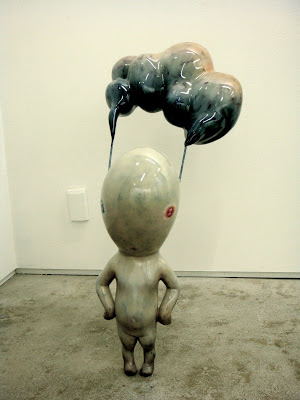
Sachiko Miki. Muffler, 2009, FRP, acrylic, iron, H 880xW 420xD 440mm

More humanoids could be seen just a short walk from the Foil, at the CASHI gallery. The CASHI is holding a solo show of Sachiko Miki, a sculptor based in Kanagawa. Miki’s creatures are quite different from Sato’s Konachi, even when large in scale (the biggest object in the exhibition is 182 cm tall), they have preciousness and gentility to them. Instead of the matt and impersonal surface that conceals Konachi’s fierceness, the creatures at CASHI are infant-like. They have big heads and translucent skin with warm pink patches and see-though veins. Their entire presence screams vulnerability. Miki works with FRP and acrylic which allows her to achieve weightlessness in motion, letting her creatures leap and extend all the way without breaking under their own weight.

"Medicine and Art: Imaging a Future for Life and Love"

View of the video installation by Magnus Wallin (Excercise Parade, 2001, double backprojection, 3-D animated video). Image courtesy Galerie Nordenhake, Berlin

Despite its generic sounding title the Mori Art Museum’s current show insightfully combines the old (Leonardo da Vinci) and the new (Damien Hirst), medical equipment and art, Nihonga painting and contemporary installations. The common tissue here, literally, is the human body—its make-up, its existence and functions, its alteration and deterioration.

The exhibition is immensely enjoyable as it presents more than a mere glimpse into the ways artists see humans and humanity. Their approaches, that run a gamut from admiration to pity, from curiosity to detachment, inevitably provoke a similar range of emotions in the visitors to the show. Many instances that cause such poignant reactions, not surprisingly, involve death, children and premature aging: Walter Schels’ sullen photographs of an 18 month-old shortly before and immediately after her death (2004) and Patricia Piccinini’s prematurely aged Game Boys (2002) are just two examples. On the opposite end of the spectrum is Gilles Barbier’s cheeky installation of the aged superheroes (L’Hospice, 2002), featuring saggy and wrinkly Wonderwoman, prone Captan America fit with an i.v., Superman supported by a walker and the Catwoman, catnapping in front of the turned off television.

Because the three sections of the show emphasize primarily the subject matter of the works, those who come in hopes of unadulterated aesthetic experiences from the art featured alongside various tomes on anatomy and scores of prosthetic limbs might end up disappointed. To be sure, looking through the medical artifacts (most of them from the Wellcome Trust collection) requires a different mode of seeing from that suitable for conceptual art, pen drawings by Leonardo, or Nihonga painting. The show’s visual schmorgesborg of art and manufactured articles forces the viewers to arbitrate continuously between their thinking and their emotions. Ironically, it is our very humanity that hinders our perception. The emotional stakes make it next to impossible to step back and allow for a duly museum detachment.

A tip: when you make it to Lee Byung Ho’s 2009 Vanitas Bust in the room before last (right next to the Game Boys), take your time looking at the bust. The show is on through February 28, 2010.

Mario García Torres, "Unspoken Dailies"

Mario Garcia Torres, “Unspoken Dailies”, 2003-2009, 16mm black and white film, 66 min. Courtesy of Taka Ishii Gallery

Torres’ feature length movie contains no words. Nor does it need to. This tribute to the enigmatic Dutch artist Bas Jan Ader who is as well known for his work on celluloid as for his mysterious disappearance in the aftermath of an attempted crossing of the Atlantic in a 12 foot boat tackles memory and time. The 16mm movie recalls Ader’s on-camera falls and introvert close-ups, but it goes a step further, taking the viewers into the realms of the unsaid and the undone.

The movie, shot in real time, features Mexican actor Diego Luna well-known from his mainstream works (Y tu mama también, 2001, Milk, 2008). In a simulation of a prolonged screen test Luna was handed a script (based on Torres’ academic paper “Around Bas Jan Ader” presented at a conference in 2004) and is placed in a sparsely furnished space with only a table, a chair, a plant, a wall clock (the very one installed in the galleries, featured in the photo above), and a glass of water. The paper is now a script, and the actor has been instructed to read it, silently, for the first time, as the camera rolled. While it might not seem as a premise for the most exciting 66 minutes ever spent, the movie proves otherwise. Punctuated with Luna’s subtle expressions, the inevitable yet titillating advancement of the clock’s hands, and an original score by Alejandro Ross, it makes for a very engaged viewing. Shot by Alexis Zabé. I suggest that before going to see the feature you check out some of Bas Jas Ader’s work here.

This is Torres’s second solo show in Japan, but this young conceptual artist had already made a reputation for himself both in Europe and the US. A graduate of the California Institute of the Arts (2005), Torres lists Jeu de Paume (2009), Kunsthalle Zurich (2008) and Stedelijk Museum (2007) among others on the list of solo exhibition venues.

On through December 12 at the Taka Ishii gallery. Screenings at 13:00, 15:00 and 18:00 daily.

ARTFORUM Critics’ Picks: Shinro Ohtake


Beach 8
2009
Oil, oilstick, acrylic, printed matter, color copy, sticker, sand, seeds, varnish, metal and acrylic board in custom frame
42.8 x 35.3 cm

Courtesy of Take Ninagawa and the artist


My review of Shinro Ohtake’s “Shell & Occupy 4” is now up on the Artforum page.