Posted
on May 22, 2019, 12:31 PM,
by jfriedman,
under Johannes Vermeer.
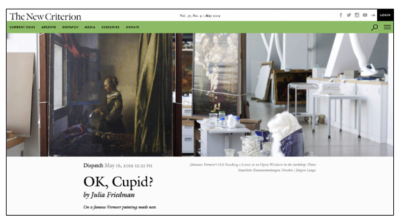
My latest article for TheNew Criterion explores how one of Vermeer’s iconic paintings known for its minimalist subtlety, was, in fact, didactic and obvious. The “Girl Reading a Letter At an Open Window,” now in Staatliche Kunstsammlungen Dresden, originally contained an image of a giant Cupid painting on the back wall. The Cupid was overpainted after Vermeer’s death, adding to the mystery of the subject matter. Now the work is undergoing restoration to its original, unambiguously campy love-story state.
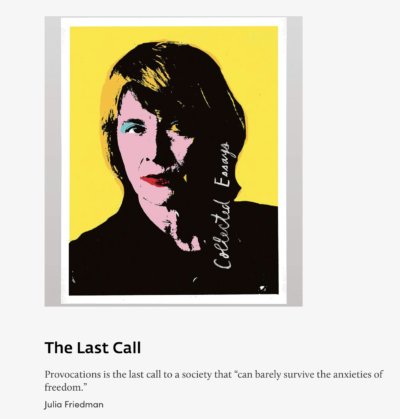
Here is my review of her latest book Provocations (Pantheon, 2018), in which I tried to contextualize Paglia’s recent writings on sex, gender, art, education and the #MeToo within the last three decades of her scholarship, as well as her writing for the wider public. I think that the irony of what is happening right now is that the passage of time had proven Camille Paglia to be right on many accounts. She is certainly a provocateur, or provocatrice, as the case may be, but in my view she is hardly a controversial thinker.
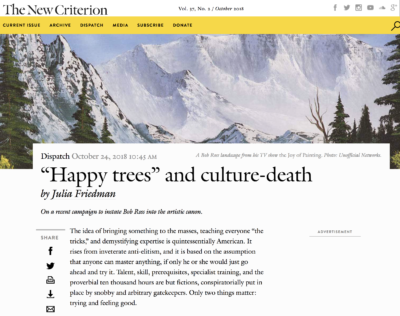
If we take Henri Matisse’s famous assertion that art should be something like a good armchair in which to rest from physical fatigue at face value, we might end up with something approaching the “happy [x]” philosophy of Bob Ross, whose message was perfectly suited for television—the medium which help to spread it. I discuss the Bob Ross phenomenon, and its implications for today’s American culture, in my latest article for The New Criterion.
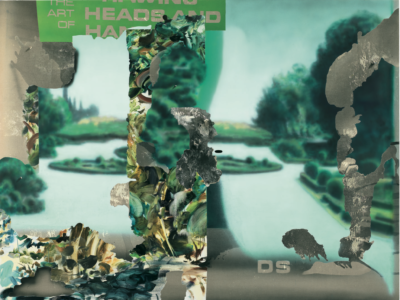
Miles McEnery Gallery’s latest publication contains an essay I wrote about the Los Angeles based painter Annie Lapin. In the essay, I place Lapin’s latest body of work “The Art of Heads and Hands” in the context of Henri Focillon’s theories about the life of forms in art. Hard copy of the catalogue is available through the gallery.
To read the essay, click on the ISSUU screen below.
Posted
on June 14, 2018, 12:40 AM,
by jfriedman,
under The New Criterion.
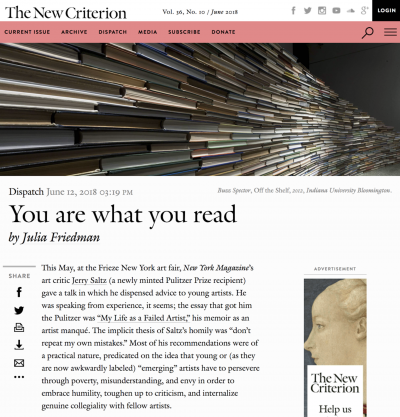
A couple of months ago I came across a fascinating little book published by Frieze in 1998. It was a bibliography intended to help young artists to become better young artists. The material was solicited from a few dozen art world people (artists, critics, curators) by Jerry Saltz, who also edited the volume. The same week I came across a more current mini-bibliography, also for the benefit of young artist. My article on the contrast between the two, and what this contrasts tells us about the shift of values, was just published in The New Criterion.
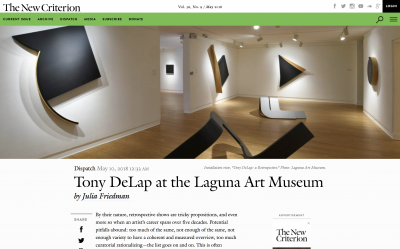
One of the bast museum shows I have seen in a while turned out to be a retrospective of a local artist in a local museum. My review of it is on The New Criterion site.
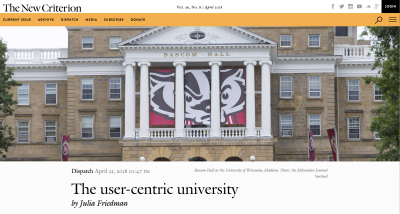
My alma mater, UW-Madison, has been making some very unsettling choices lately. More on that in my latest blog post “The user-centric university” in The New Criterion dispatches section.
Site Santa Fe: in conversation with Dave Hickey 04.15.16.
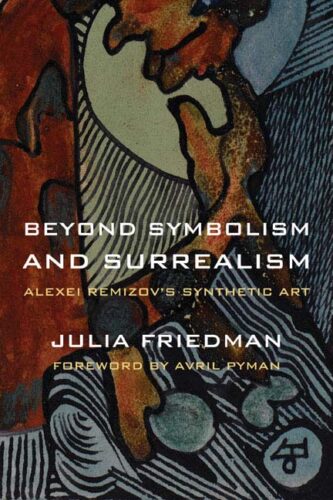
The great modernist eccentric Alexei Remizov was a “writers’ writer” whose innovative poetic prose has long since entered the Russian literary canon. Gradually expanding his working methods to make drawing an integral part of the writing process, during the 1930s and 1940s, Remizov created hundreds of albums that combined texts with collages and india ink and watercolor illustrations. (more)
Northwestern University Press
7 x 10, 300 pgs, Trade Cloth
ISBN 0-8101-2617-6 / $69.95
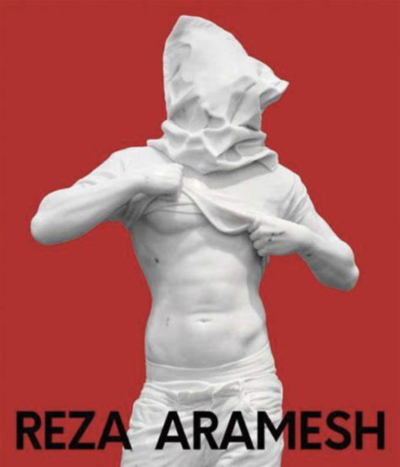
Skira Editore Milano just published a monograph on British-Iranian artist Reza Aramesh. In addition to several texts, and an interview with the artist, ACTION: BY NUMBER contains a catalogue raisonné of his work from 2002 onwards, including Aramesh’s recent marble sculpture. I discuss the art-historical genesis and cultural meaning of these spectacular and frightening works in my essay “The Meta of Marble.” (pp.124–129).
SKIRA Editore Milano
Hardcover. 248 pages, 153 ill., size 24x28cm
ISBN 978-88-572-5285-8
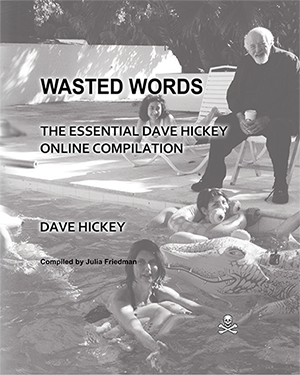
Between June 2014 and April 2015, Dave Hickey posted almost 3,000 digital comments on social media, prompting nearly 700,000 words in response from art lovers, acolytes, and skeptics. Wasted Words is an unedited comprehensive transcript of these exchanges. This polyphonic digital discourse reveals the range of Hickey’s strong opinions, as he embarks on a crypto-enlightenment project for the benefit of "dunces" and "pricks." Paperback, 586 pages, 2016 ISBN-10: 1517287103
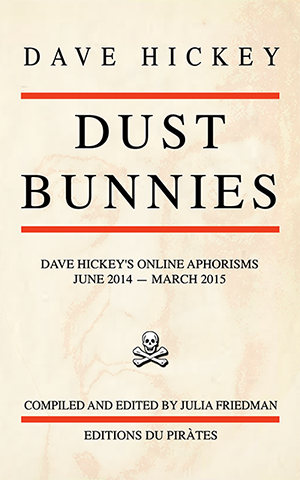
Dustbunnies is an assemblage of “swept up” fragments that came from a vast digital discourse that took place in Dave Hickey’s social media space between June 2014 and March 2015. During that time Hickey posted almost 3,000 comments, prompting nearly 700,000 words in response from art lovers, acolytes and skeptics. Wasted Words, the resulting volume, is an unedited comprehensive transcript of these exchanges. Its pendant publication, Dustbunnies, distills Hickey’s richly aphoristic comments, extracted from various discussion threads. Paperback, 124 pages, 2016 ISBN-10: 152327266X
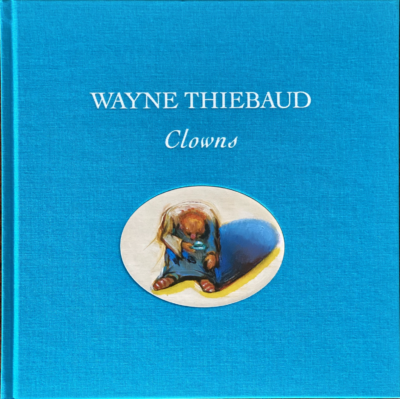
Over the past seven years Wayne Thiebaud has made dozens of paintings, drawings, and etchings of clowns. Like much of his work, this latest series is in a sense autobiographical. During his boyhood in Long Beach he looked forward to the visits of a traveling Ringling Brothers circus and sometimes helped out behind the scenes in exchange for tickets. The costumes, faces, and antics of the clowns were the beginning of a lifelong fascination for him. The clown series is its culmination, in which the now 100-year-old artist revisits those early memories.
In December 2019 Wayne Thiebaud unveiled a selection from his clown series at the San Francisco gallery founded by his son, Paul Thiebaud. The Laguna Art Museum exhibition will be a version of the Paul Thiebaud Gallery exhibition, featuring more than forty works.
Fully illustrated with 56 artwork reproductions. Essay by Dr. Julia Friedman. Interview with the artist by Janet Bishop, the Thomas Weisel Family Chief Curator and Curator of Painting and Sculpture at San Francisco Museum of Modern Art.
Hardcover: 100 pages; ISBN-10: 0578798573ISBN-13: 978-0578798578
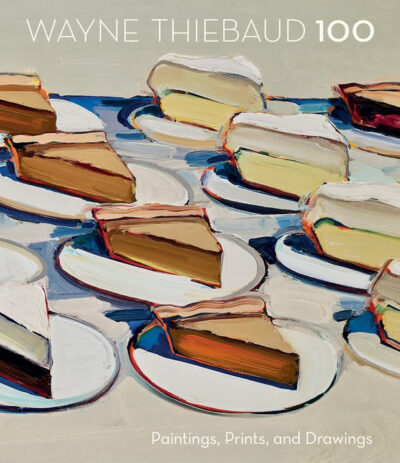
Celebrating the 100th birthday of one of America's most respected and beloved artists, Wayne Thiebaud 100: Paintings, Prints, and Drawings honors a lifetime of extraordinary achievements across many genres. Best known for his tantalizing paintings of desserts, Thiebaud has long been affiliated with Pop Art, though his body of work is far more expansive, continuing to grow as the artist approaches his milestone birthday. Across the decades, Thiebaud has explored various details of American life through his art from urban views and rural landscapes to clowns and household items all the time continuing to explore the food subjects that made him famous.
Wayne Thiebaud 100 accompanies an exhibition of the same name, organized by the Crocker Art Museum. In addition to the 100 paintings, prints, and drawings featured in the exhibition, this publication includes numerous other contextual paintings by Thiebaud, art by the masters who inspired him, and photographs of the artist with family and friends, taken over the course of his extraordinary career.
Hardcover : 212 pages
ISBN-10 : 1087501172
Dimensions : 9.8 x 0.9 x 11.3 inches
ISBN-13 : 978-1087501178
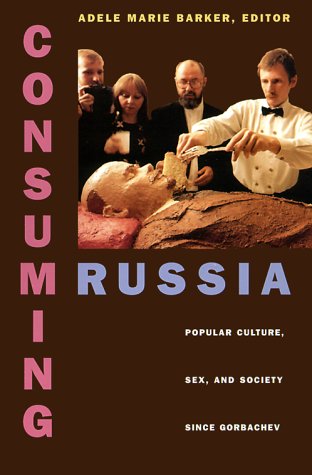
Consuming Russia: Popular Culture, Sex, and Society since Gorbachev
Adele Marie Barker (Editor), Eliot Borenstein (Contributor), Julia Friedman (Contributor), Adam Weiner (Contributor), Elizabeth Kristofovich Zelensky (Contributor), Robert Edelman (Contributor)
With the collapse of the Soviet empire in the late 1980s, the Russian social landscape has undergone its most dramatic changes since the Bolshevik Revolution in 1917, turning the once bland and monolithic state-run marketplace into a virtual maze of specialty shops—from sushi bars to discotheques and tattoo parlors... (more)
Paperback: 488 pages
Publisher: Duke University Press Books (June 10, 1999)
Language: English
ISBN-10: 0822323133
ISBN-13: 978-0822323136
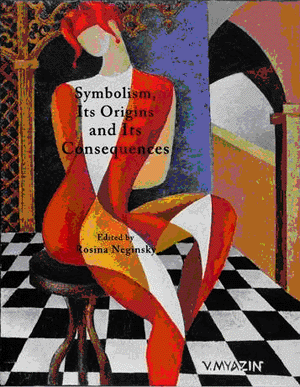
“A Powerless Seeker: Merezhkovsky’s Romance as Life-Writing” by Julia Friedman
In Symbolism, its Origins and Consequences. Edited by Rosina Neginsky. Cambridge: Cambridge Scholars, 2010
Hardcover: 665 pages
Publisher: Cambridge Scholars Publishing
New edition edition (October 1, 2010)
Language: English
ISBN-10: 1443823929
ISBN-13: 978-1443823920
“The Writing-Drawing Continuum of Alexei Remizov,” by Julia Friedman
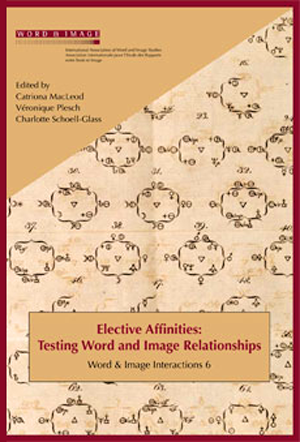
"Elective affinities" - a notion originally borrowed by Goethe for his 1809 novel of the same title from eighteenth-century chemistry - here refers to the active role of the two partners in the relationship of the pictorial and the verbal...
In In Elective Affinities: Word & Image Interactions 6, 2008
Edited by Catriona McLeod, Véronique Plesch and Charlotte Schoell-Glass.
Amsterdam and Atlanta: Rodopi
Paperback: 422 pages
Publisher: Rodopi (June 20, 2009)
Language: English
ISBN-10: 9042026189
ISBN-13: 978-9042026186
“Alexei Remizov’s Creative Act,” by Julia Friedman. Edited by Maurice Geracht and Frédéric Ogée.
In Interfaces: Image Text Language, vol. 29, 2010
In this essay, I look beyond the familiar arguments for preservation or removal to ask what these objects actually do in civic life. Monuments compress history into visible form, but they also expose the tensions between reverence and critique. At a moment when public memory is deeply contested, monuments become mirrors, reflecting contemporary values as […]
Rejecting sentimental or anecdotal portraiture, Thiebaud cultivates a suspended psychological charge, inviting viewers into the role of Wollheim’s “unrepresented spectator.” His sitters—poised before or after action—occupy pared-down spaces where gesture is displaced by the quiet gravity of presence. Through this deliberate withholding, Thiebaud reanimates classical problems of painting, aligning himself with Velázquez and Manet while […]
The notorious 19th-century anarchist Mikhail Bakunin, who proclaimed that “the urge for destruction is also a creative urge,” has found an unlikely disciple in Trump. Considered together, the 1980 and 2025 episodes teach the lesson that destruction can be a form of authorship. Once the reliefs were gone, their loss defined both the building and […]
Walter Benjamin called the twentieth century “the age of mechanical reproduction,” but his contemporaries were still capable of distinguishing between a celebrity’s real personality and her image. The twenty-first century is the age of digital reproduction, and it forces us to ask whether the general public still possesses the capacity to recognize such a distinction. […]
Perhaps this is why Alpers is befuddled by today’s disciplinary confusion in which art, the master, is subjugated by art history, supposedly its emissary. Consider the following remark she made in a 2022 follow-up to the earlier conversation with Ziegler: “I agree with my great, late art historian friend Michael Podro, who said that painting […]
“Wayne Thiebaud: Art Comes from Art,” which opened at the California Palace of the Legion of Honor in San Francisco on March 22, is organized by the Fine Arts Museums of San Francisco and curated by Timothy Anglin Burgard. Its premise, spelled out in the title, is straight forward enough and firmly based on the […]
When British sculptor Thomas J Price explains that his “strategy of inclusion” will counter the “endless stream of limiting tropes and identities for Black people,” he is inadvertently mimicking totalitarian injunctions.