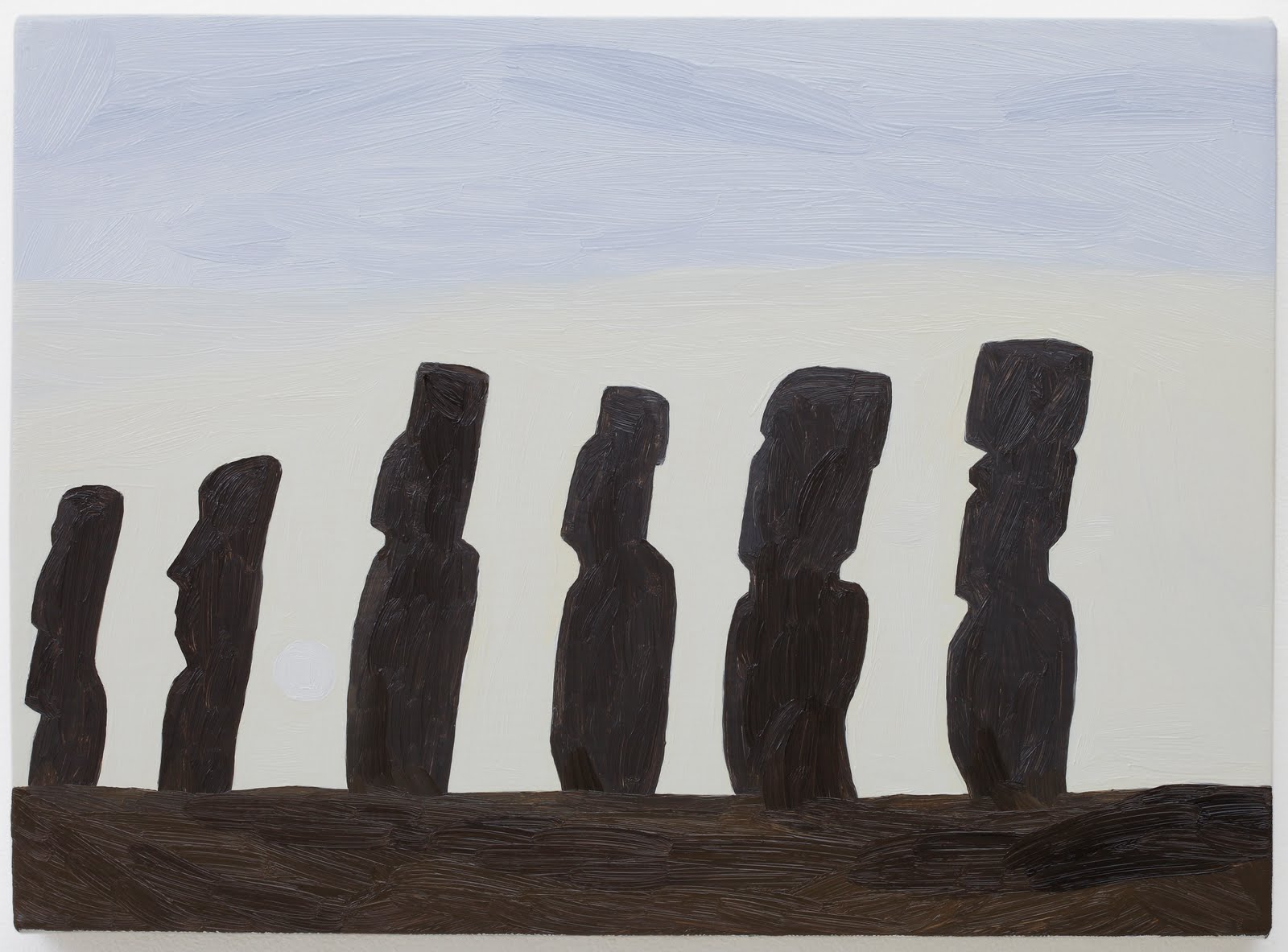
Just a couple of blocks away from Take Ninagawa, Gallery Side 2 is showing the new oil paintings of Yuko Murata. Murata’s subject matter of choice is patently representational—animals, plants and landscapes, but despite their mimetic nature her images seem to go beyond what is immediately shown in them. These remarkably restrained oils have an almost Symbolist (think Puvis de Chavannes) ring to them, they display the silence and the melancholy normally foreign to contemporary art. The animals and plants function first and foremost as motifs that prompt Murata’s oneiric improvisations.
There are two events in conjunction with this exhibition: a book party at BOOK 246 July 9th, and the artist talk at NADiff July 16.
Comments Off on Yuko Murata
Posted
on June 27, 2010, 4:59 AM,
by jfriedman,
under
Uncategorized.
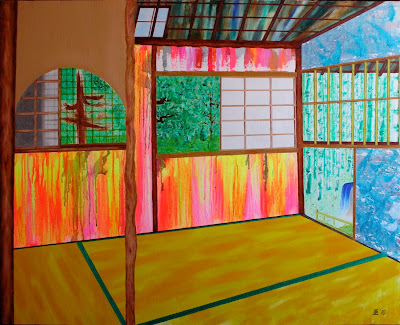
亜 真里男 Mario A.
「新日本画(お茶室)」”Shin Nihon-ga” (Tea-house) 2010年
油彩・キャンヴァス・F40
2010, oil on canvas, 80.3×100 cm
Mario A.’s week-long show is opening at the Bunkamura Gallery this upcoming Wednesday, June 30th. For more information check the gallery website.
Comments Off on Mario A. at BUNKAMURA GALLERY

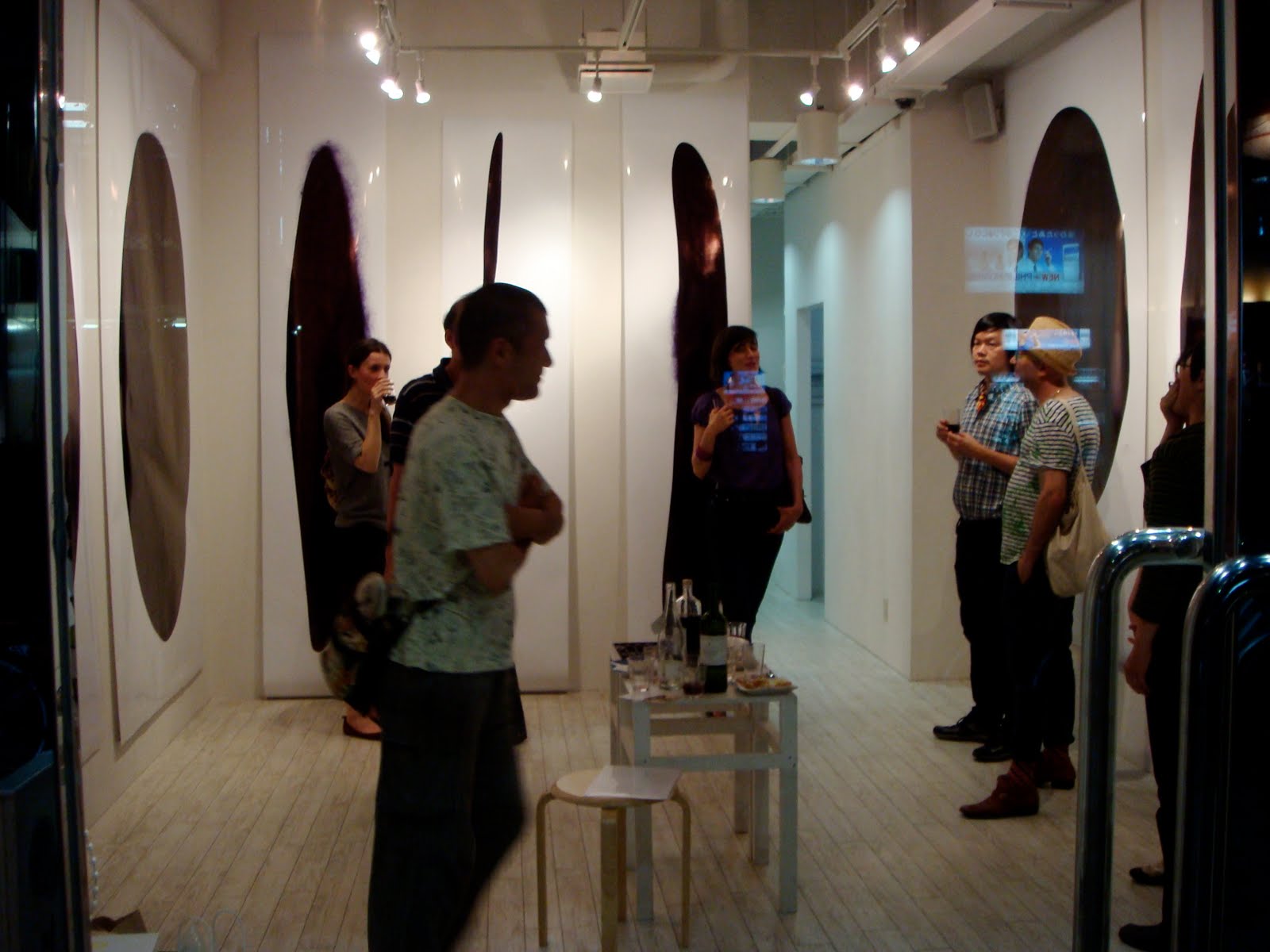
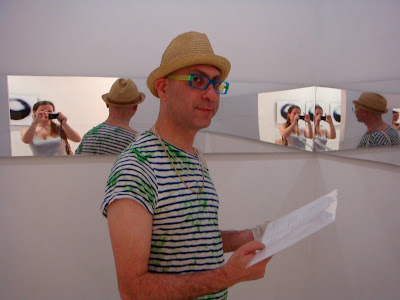
Chihiro Kabata is showing her latest work (yes, she is very prolific!) at Shinjuku Ophthalmologist Gallery. While every work in the show is done in her trademark purple ink, there are two interesting new developments. First, there is a small work where the markings are linear so that their ball-point origin is not immediately apparent. A colleague of mine pointed out that the parallel lines in this image seem to imitate a brushstroke taken across the surface and back, something like Roy Lichtenstein’s cheeky “brushstroke” in his Big Painting No. 6 (1965). The second departure from Kabata’s floating ink shapes comes in the site specific installation placed in a separate room. It consists of a strip-shaped three part mirror crossed with a jagged ink line that runs across its whole length, turning the corners with the mirror itself.
The exhibition will be up through June 27th.
Comments Off on Chihiro Kabata "事象の地平線 /Event Horizon"
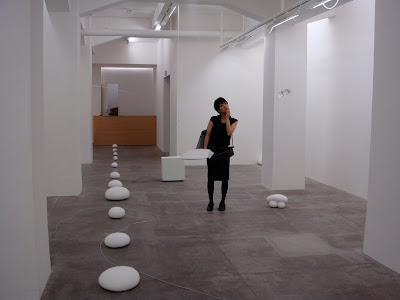
Yuta Hayakawa, installation view at αM
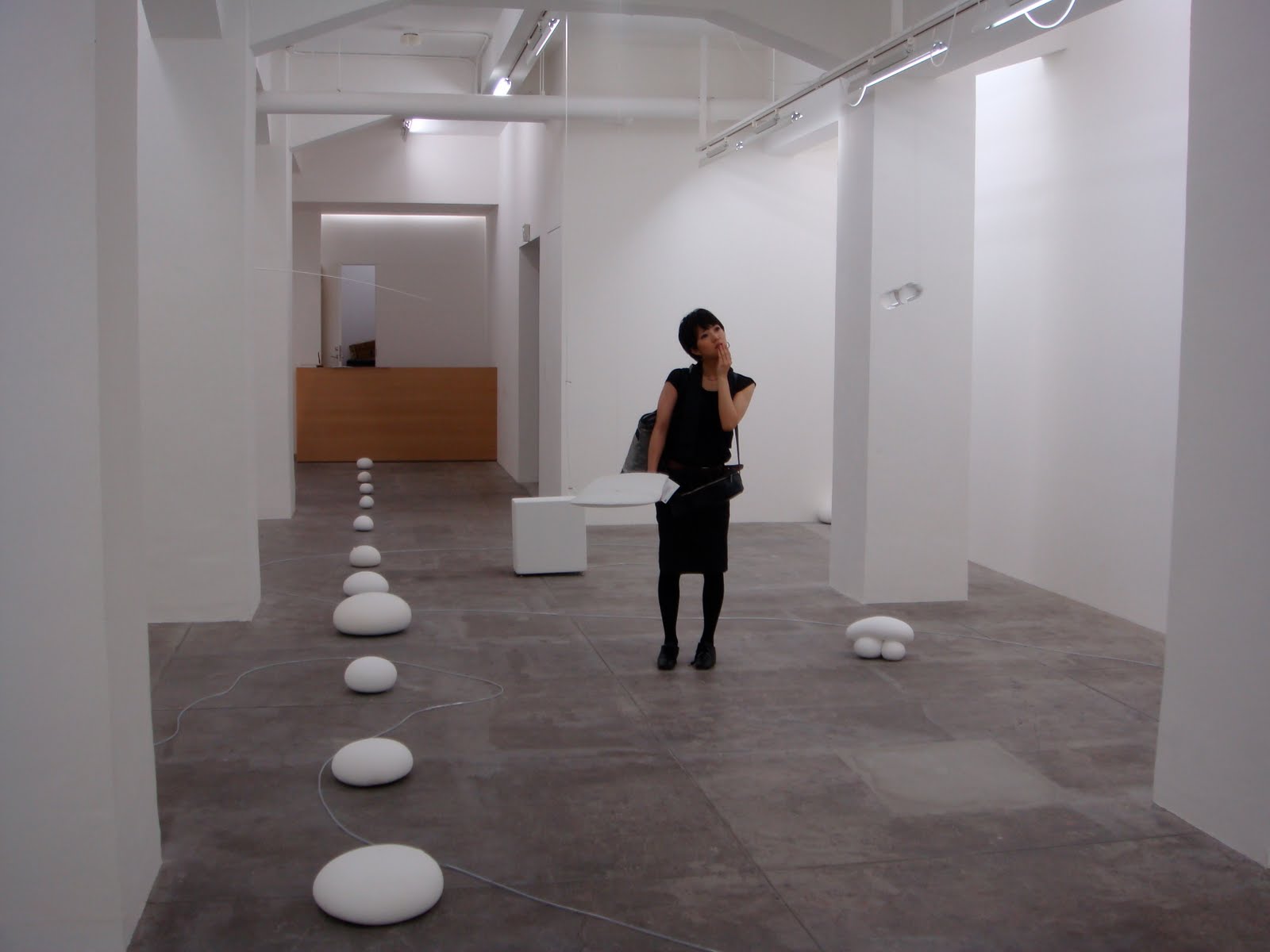
Also in Bakurocho, just a few blocks away from the Motus Fort gallery, the Muashino Art University’s gallery αM, is now hosting the new installment of their six-part series Complex Circuit—an exhibition by Yuta Hayakawa. The works, with one exception all from 2010, are monochrome and are put together compose a palpable, if bizarre, landscape of oversized pebbles, white florescent tubes, a hydraulic sculpture, a spinning bottle attached to a nearly invisible fishline sting, and a bifurcated sculpture made of wooden planks. The latter goes by a soothing title of It’s all right. The cohesion of the works on view makes Hayakawa’s exhibition look more like an installation, a bit too smooth perhaps, but also coherent and very zen.
Comments Off on Yuta Hayakawa at Gallery αM
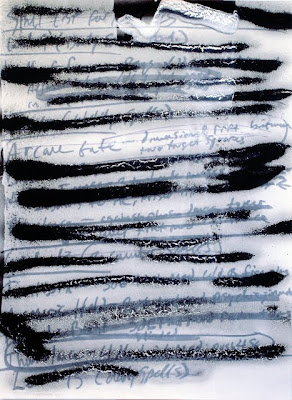
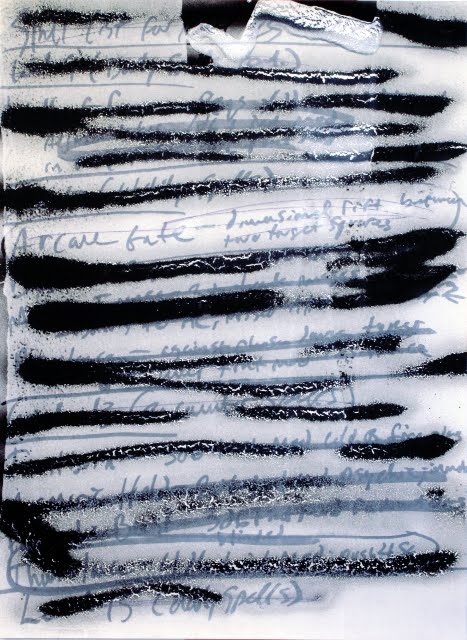
Arcane Gate, 2009
Marker, spray paint and house paint on paper
Image courtesy of Motus Fort gallery
Jeffrey Chiedo’s Motus Fort gallery is now showing the works of Kadar Brock. The key word of the exhibition is “conjuring,” in reference to the conflicting modes of painting and the obscured words and textures that come and go seemingly at the will of the artist-magitian. The two types of works on display are the monochrome mixed media paintings from 2009, like the one above, and the smaller figurative images in color. The monochromes picture the writing obscured by paint smears in what could be described as a gesture of materialization—the artist-magitian realizes the words as he crosses them out. The immateriality of the legible is made into a material sensibility using the physical solidity of paint. Several of the monochromes recall the later works of Anthony Tapies although Brock’s pictorial concerns seem to be less expressive and more phenomenological.
The other portion of the exhibition are the color multi-media Wizards paintings on paper framed by the artist (all 2010). These already have their designated art history references (i.e. Holbein, Titian, Carravagio), and present, as the title suggests, a gallery of various wizards and conjurors. One name not mentioned in the dead artist roster was Mark Chagall’s, but I certainly sensed his hovering hand all around the color wizards.
The show is on view through July 17th.
Comments Off on Kadar Brock "Conjuring and Dispelling"

Nobuyoshi Araki, “Koki No Shashin : Photographs of A Seventy Year Old” 2010, RP Direct print, Courtesy of Taka Ishii Gallery
With the big anniversary exhibition “Koki No Shashin : Photographs of A Seventy Year Old” at the Taka Ishii gallery having just closed, “the ultimate photographer” is featuring more of his latest work in a new show at the Rat Hole Gallery in Omotesando. It coincides with the release of Araki’s most recent publication “Sentimental Journey, Spring Journey.” You might even be able to get a glimpse at the man himself at the opening reception scheduled for 7 pm on June 11.
Comments Off on Nobuyoshi Araki
Posted
on June 8, 2010, 6:24 PM,
by jfriedman,
under
Uncategorized.
There is a new (commercial) art space in town, it opened just last month. TABLOID is self-described as a “complex culture place….where work and play are created.” Their next event is coming up this Saturday, June 12th, and looks quite interesting because it involves the very artists-designers that made a big splash at S/S 2009 Tokyo Fashion Week. It will consist of Makoto Tanijiri’s installation (doors open at 17:00), followed by a show of the ultra-modern brand writtenafterwards. The show is from 18:00 until 18:30. After that you can view the brand’s installation and drop in on another one by coconogacco x driff open-classroom. Or, you can join the on-site party organized by Art Hotel Nest Tokyo.
The event, enigmatically titled “Crime and Punishment” is curated by fashion designer Yoshikazu Yamagata. The entry fee is ¥1500. You can find all the information on the ART HOTEL NEST TOKYO page.
Comments Off on writtenafterwards + Makoto Tanijiri and more