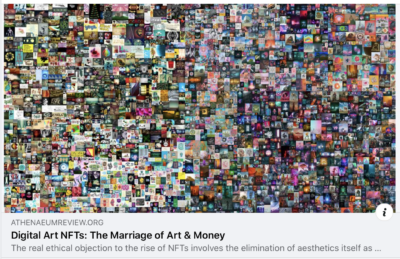
The relationship between art and money has always been symbiotic. It has been equally true with papal patronage in sixteenth century, and with the interwar European avant-garde whose fortunes, according to Greenberg, were inexorably linked to the market ‘by an umbilical cord of gold.’ After all, art and money are basically similar phenomena: both are valuable and significant systems of symbols. The twentieth century was replete with artists questioning the relationship between art and money. Their difference from Beeple was that they were looking for ways to uncouple the pair, rather than fuse them. As early as 1914, Duchamp’s revolutionary concept of the ‘readymade’ had undermined the process of commodification that had engulfed the artworld. Along with his Dadaist allies, Duchamp succeeded in redefining the fine arts, moving away from the given of physical painting and sculpture and towards serialized, de-commodified, temporary or even traceless performances and manifestos.
By insisting that a fictitious ‘R. Mutt’ had the right to anoint a urinal as art because ‘whether Mr. Mutt with his own hands made the fountain or not has no importance. He CHOSE it,’ Duchamp initiated what the late David Graeber called the ‘aesthetic validation of managerialism.’ A lowly plumbing fixture can be art, as long as someone (who did not even create it) calls it art. The task of validation, and the creation of value, later devolved from artists to curators, who could throw ordinary objects into the mix along with bona fideartworks, confident that no one could legitimately object. Today this function falls to auction houses which, in Graeber’s words, use ‘money as a sacral grace that baptizes ordinary objects magically, turning them into a higher value.’ That is exactly what happened to Beeple’s opus on March 11, 2021 when the sale closed at $69,346,250.
Posted
on March 17, 2021, 3:20 PM,
by jfriedman,
under exhibition review.
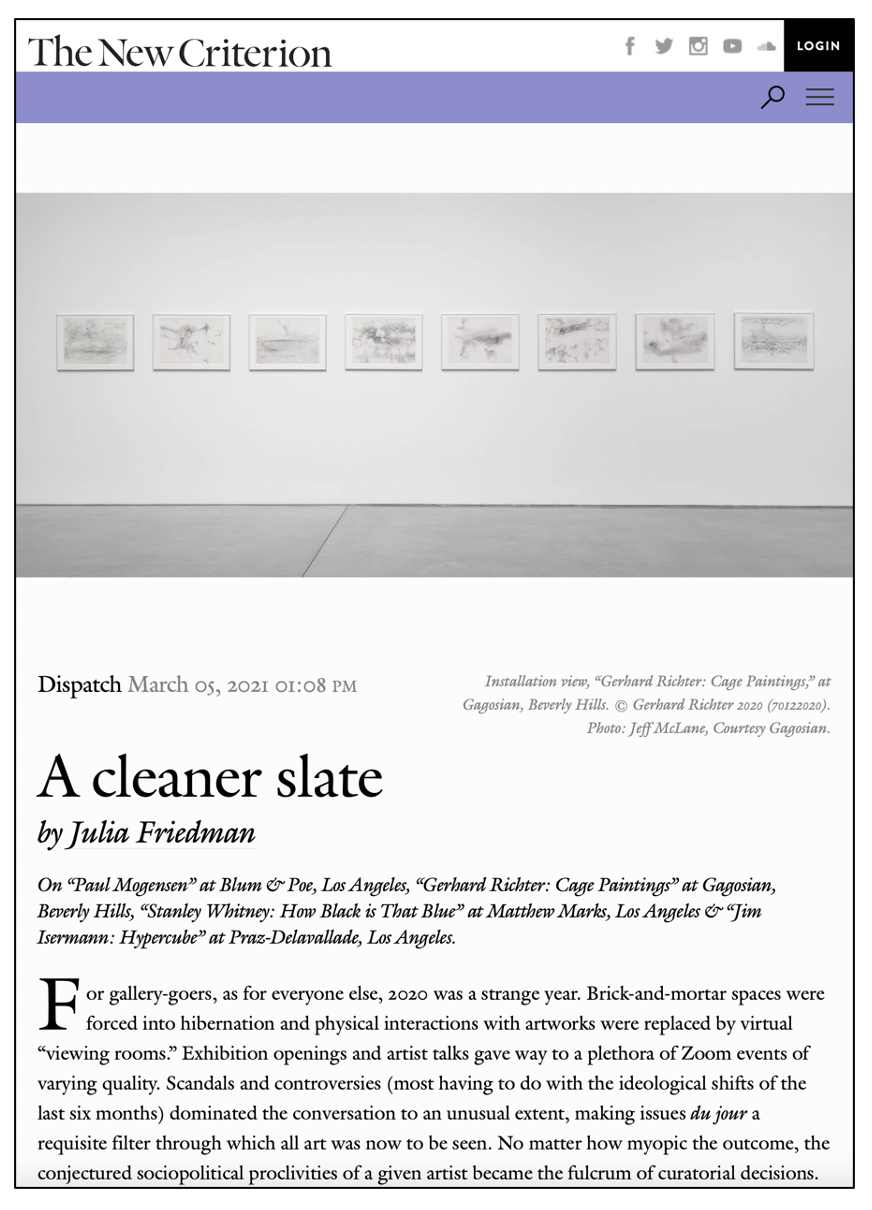
In early March, The New Criterion published “A Cleaner Slate”—my review of four exhibitions of abstract painting: “Paul Mogensen” at Blum & Poe, Los Angeles, “Gerhard Richter: Cage Paintings” at Gagosian, Beverly Hills, “Stanley Whitney: How Black is That Blue” at Matthew Marks, Los Angeles and “Jim Isermann: Hypercube” at Praz-Delavallade, Los Angeles.
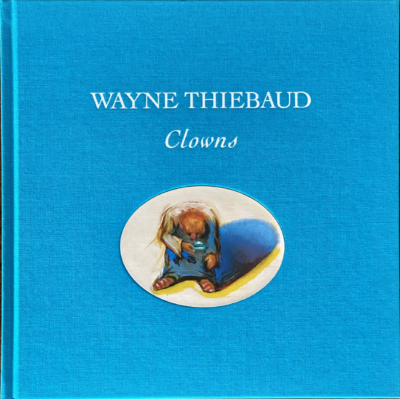
Last month, the Laguna Art Museum recorded my tour of Wayne Thiebaud’s “Clowns.” This exhibition includes over forty items that compose the painter’s latest circus-themed body of work. The show has been installed at the museum since early December 2020, but is yet to be opened to to public due to Covid-19 restrictions.
In this thirty minute walk-through I discuss a dozen paintings, drawings (including mixed media drawings), and etchings in the exhibition. LAM will re-open March 26. Until then, here is my modest contribution. Covid hair comes with. 🙂
I am delighted to have had a chance to contribute an essay for the catalogue of Wayne Thiebaud’s Clowns exhibition at the Laguna Art Museum. You can purchase the catalogue in LAM’s online store.
The catalogue contains 55 color plates and an interview with the painter conducted by Janet Bishop (Thomas Weisel Family Chef Curator and Curator of Painting and Sculpture at the San Francisco Museum of Modern Art).
Due to the Covid-19 pandemic, the 2021 annual California Cool Auction at the Laguna Art Museum is entirely online. Here is my virtual tour of the auction where I highlight some of this year’s hidden gems.
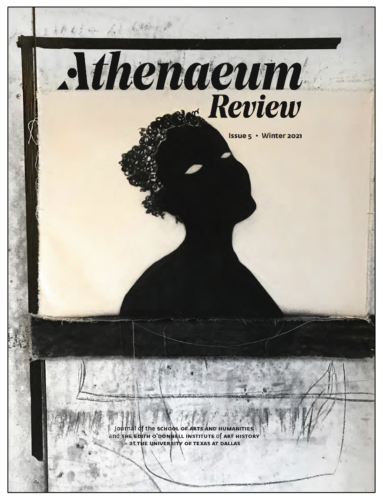
The Winter 2021 issue of arts and humanities quarterly Athenaeum Review is out on newsstands. Its Current Affairs section contains my essay “Classicism by Decree” (pp. 148–155) about an attempted change in the aesthetic direction of federal architecture in the US. Since 1962, the General Services Administration (the same governmental body that was recently in the news for not “ascertaining” the results of 2020 presidential race) has been relying on the Guiding Principles for Federal Architecture with its two-fold requirement of practicality and symbolism in all federal buildings. These requirements were put in place the aim of maximizing architectural innovation while upholding quality and longevity of construction. The new rules, if signed into law, would mandate that all federal buildings shall be erected in “classical architectural style.” In the essay, I discuss the pitfalls of promoting one specific architectural style at the expense of an open meritocratic competition. This is especially the case if the preferred style is a derivation of classicism, given the contentious history of association between classical architecture and totalitarian regimes in the past century. Mandating classicism by decree seems like a very bad idea.
Update: On December 22, President Trump signed “Make Federal Architecture Beautiful Again” Executive Order into law. Here is a link to the coverage of the Executive Order, across the political spectrum.
Site Santa Fe: in conversation with Dave Hickey 04.15.16.
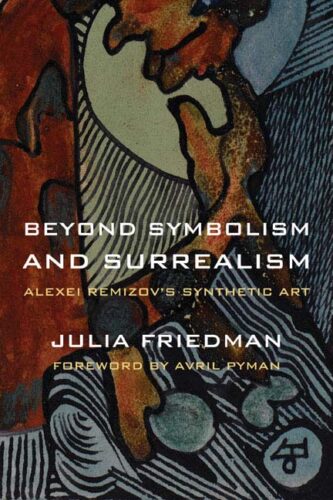
The great modernist eccentric Alexei Remizov was a “writers’ writer” whose innovative poetic prose has long since entered the Russian literary canon. Gradually expanding his working methods to make drawing an integral part of the writing process, during the 1930s and 1940s, Remizov created hundreds of albums that combined texts with collages and india ink and watercolor illustrations. (more)
Northwestern University Press
7 x 10, 300 pgs, Trade Cloth
ISBN 0-8101-2617-6 / $69.95
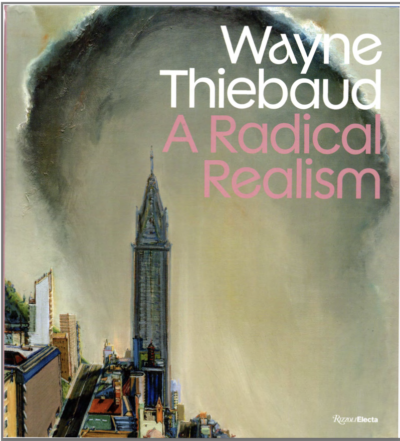
The first critical look at the artist’s work since his death, focusing on his deep connections to California and his distinctive approach to realism, by those who knew him well.
This book examines the extraordinary career of Wayne Thiebaud (1920–2021) and highlights his iconic representations of everyday scenes. Born in Mesa, Arizona, Thiebaud’s formative years in Southern California and his long-term residence in Northern California crucially influenced his work.
Publish Date: September 09, 2025
Format: Hardcover
Category: Art - Individual Artists - Monographs
Publisher: Rizzoli Electa
Trim Size: 9-1/4 x 10-1/4
Pages: 192
US Price: $55.00
CDN Price: $75.00
ISBN: 978-0-8478-7574-0
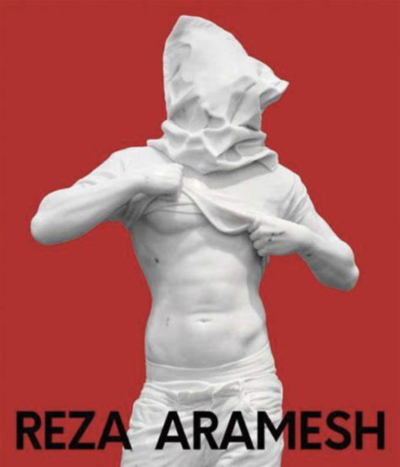
Skira Editore Milano just published a monograph on British-Iranian artist Reza Aramesh. In addition to several texts, and an interview with the artist, ACTION: BY NUMBER contains a catalogue raisonné of his work from 2002 onwards, including Aramesh’s recent marble sculpture. I discuss the art-historical genesis and cultural meaning of these spectacular and frightening works in my essay “The Meta of Marble.” (pp.124–129).
SKIRA Editore Milano
Hardcover. 248 pages, 153 ill., size 24x28cm
ISBN 978-88-572-5285-8
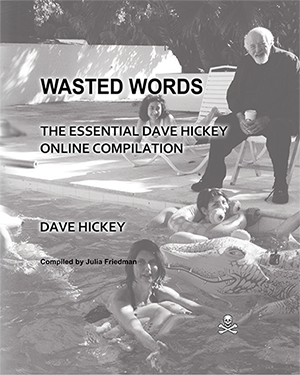
Between June 2014 and April 2015, Dave Hickey posted almost 3,000 digital comments on social media, prompting nearly 700,000 words in response from art lovers, acolytes, and skeptics. Wasted Words is an unedited comprehensive transcript of these exchanges. This polyphonic digital discourse reveals the range of Hickey’s strong opinions, as he embarks on a crypto-enlightenment project for the benefit of "dunces" and "pricks." Paperback, 586 pages, 2016 ISBN-10: 1517287103
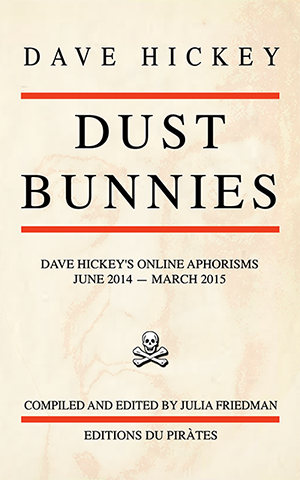
Dustbunnies is an assemblage of “swept up” fragments that came from a vast digital discourse that took place in Dave Hickey’s social media space between June 2014 and March 2015. During that time Hickey posted almost 3,000 comments, prompting nearly 700,000 words in response from art lovers, acolytes and skeptics. Wasted Words, the resulting volume, is an unedited comprehensive transcript of these exchanges. Its pendant publication, Dustbunnies, distills Hickey’s richly aphoristic comments, extracted from various discussion threads. Paperback, 124 pages, 2016 ISBN-10: 152327266X
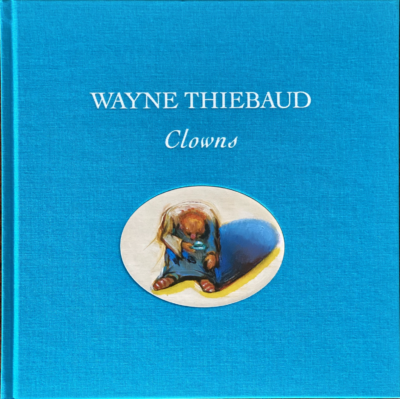
Over the past seven years Wayne Thiebaud has made dozens of paintings, drawings, and etchings of clowns. Like much of his work, this latest series is in a sense autobiographical. During his boyhood in Long Beach he looked forward to the visits of a traveling Ringling Brothers circus and sometimes helped out behind the scenes in exchange for tickets. The costumes, faces, and antics of the clowns were the beginning of a lifelong fascination for him. The clown series is its culmination, in which the now 100-year-old artist revisits those early memories.
In December 2019 Wayne Thiebaud unveiled a selection from his clown series at the San Francisco gallery founded by his son, Paul Thiebaud. The Laguna Art Museum exhibition will be a version of the Paul Thiebaud Gallery exhibition, featuring more than forty works.
Fully illustrated with 56 artwork reproductions. Essay by Dr. Julia Friedman. Interview with the artist by Janet Bishop, the Thomas Weisel Family Chief Curator and Curator of Painting and Sculpture at San Francisco Museum of Modern Art.
Hardcover: 100 pages; ISBN-10: 0578798573ISBN-13: 978-0578798578
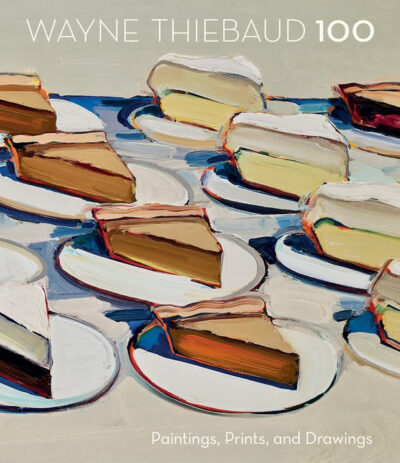
Celebrating the 100th birthday of one of America's most respected and beloved artists, Wayne Thiebaud 100: Paintings, Prints, and Drawings honors a lifetime of extraordinary achievements across many genres. Best known for his tantalizing paintings of desserts, Thiebaud has long been affiliated with Pop Art, though his body of work is far more expansive, continuing to grow as the artist approaches his milestone birthday. Across the decades, Thiebaud has explored various details of American life through his art from urban views and rural landscapes to clowns and household items all the time continuing to explore the food subjects that made him famous.
Wayne Thiebaud 100 accompanies an exhibition of the same name, organized by the Crocker Art Museum. In addition to the 100 paintings, prints, and drawings featured in the exhibition, this publication includes numerous other contextual paintings by Thiebaud, art by the masters who inspired him, and photographs of the artist with family and friends, taken over the course of his extraordinary career.
Hardcover : 212 pages
ISBN-10 : 1087501172
Dimensions : 9.8 x 0.9 x 11.3 inches
ISBN-13 : 978-1087501178
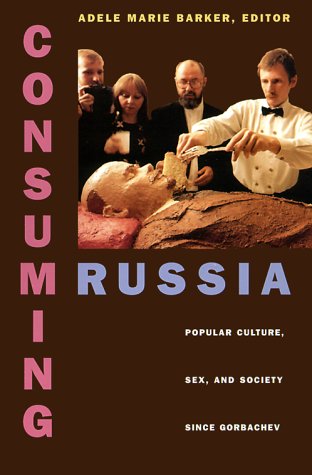
Consuming Russia: Popular Culture, Sex, and Society since Gorbachev
Adele Marie Barker (Editor), Eliot Borenstein (Contributor), Julia Friedman (Contributor), Adam Weiner (Contributor), Elizabeth Kristofovich Zelensky (Contributor), Robert Edelman (Contributor)
With the collapse of the Soviet empire in the late 1980s, the Russian social landscape has undergone its most dramatic changes since the Bolshevik Revolution in 1917, turning the once bland and monolithic state-run marketplace into a virtual maze of specialty shops—from sushi bars to discotheques and tattoo parlors... (more)
Paperback: 488 pages
Publisher: Duke University Press Books (June 10, 1999)
Language: English
ISBN-10: 0822323133
ISBN-13: 978-0822323136
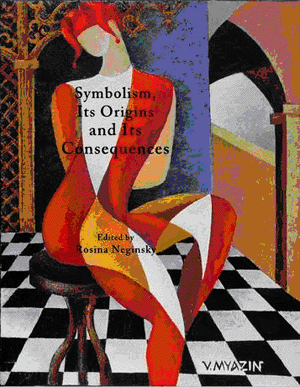
“A Powerless Seeker: Merezhkovsky’s Romance as Life-Writing” by Julia Friedman
In Symbolism, its Origins and Consequences. Edited by Rosina Neginsky. Cambridge: Cambridge Scholars, 2010
Hardcover: 665 pages
Publisher: Cambridge Scholars Publishing
New edition edition (October 1, 2010)
Language: English
ISBN-10: 1443823929
ISBN-13: 978-1443823920
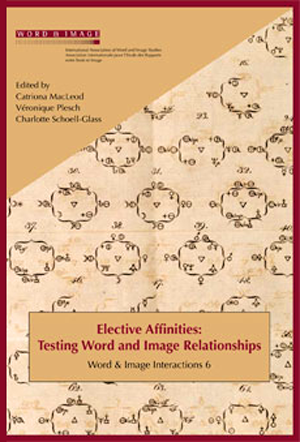
“The Writing-Drawing Continuum of Alexei Remizov,” by Julia Friedman
"Elective affinities" - a notion originally borrowed by Goethe for his 1809 novel of the same title from eighteenth-century chemistry - here refers to the active role of the two partners in the relationship of the pictorial and the verbal...
In In Elective Affinities: Word & Image Interactions 6, 2008
Edited by Catriona McLeod, Véronique Plesch and Charlotte Schoell-Glass.
Amsterdam and Atlanta: Rodopi
Paperback: 422 pages
Publisher: Rodopi (June 20, 2009)
Language: English
ISBN-10: 9042026189
ISBN-13: 978-9042026186
“Alexei Remizov’s Creative Act,” by Julia Friedman. Edited by Maurice Geracht and Frédéric Ogée.
In Interfaces: Image Text Language, vol. 29, 2010
Hockney's own favorite story made the case better than any critic could: a ceramic owl by Picasso, he liked to point out, contains far less visual information than a stuffed specimen, yet it captures something the stuffed bird never will—the experience of a human being looking. Everything he made afterward was an argument for that […]
Following the death of Hilde Lynn Helphenstein, better known as Jerry Gogosian, much of the public discussion focused on the circumstances of her death rather than the ideas she spent years articulating through her work. This essay examines Helphenstein's place within a broader history of institutional critique, arguing that the Jerry Gogosian project adapted that […]
In this response to artist Josh Kline’s essay on the state of American art, I take a closer look at the idea that the art world has recently fallen into crisis. Kline argues that today’s system is no longer able to support artists in meaningful ways. I question that view by looking at the history […]
In 2026, the viral photograph of the former prince briefly entered the Louvre, but only to intensify its existing meaning by borrowing the institution’s authority. That shift tells us less about the guilt of the individuals involved than it does about the evolution of spectacle itself. Above all, it suggests an ominous, growing impatience with […]
In this essay, I look beyond the familiar arguments for preservation or removal to ask what these objects actually do in civic life. Monuments compress history into visible form, but they also expose the tensions between reverence and critique. At a moment when public memory is deeply contested, monuments become mirrors, reflecting contemporary values as […]
Rejecting sentimental or anecdotal portraiture, Thiebaud cultivates a suspended psychological charge, inviting viewers into the role of Wollheim’s “unrepresented spectator.” His sitters—poised before or after action—occupy pared-down spaces where gesture is displaced by the quiet gravity of presence. Through this deliberate withholding, Thiebaud reanimates classical problems of painting, aligning himself with Velázquez and Manet while […]
The notorious 19th-century anarchist Mikhail Bakunin, who proclaimed that “the urge for destruction is also a creative urge,” has found an unlikely disciple in Trump. Considered together, the 1980 and 2025 episodes teach the lesson that destruction can be a form of authorship. Once the reliefs were gone, their loss defined both the building and […]