Openings: Kiyosumi and Shirokane Art Complexes

Another night of openings in the Kiyosumi and Shirokane art complexes. Tomio Koyama Gallery presented video works of the Daiwa Foundation Art Prize winner Marcus Coates. His video work Dawn Chorus (2007) is a set up of several screens that show people in their natural habitat lipsynching bird songs recorded in the woodlands of Northern England.

One floor below hiromiyoshii gallery inaugurated an exhibition of Takehito Koganezawa’s planetary photography and sculptures, with a separate little room devoted to his earlier drawings and sketches.
The Kodama Gallery showed Kenji Nohara’s painting, sculpture and 3D objects. My favorite was a souvenir mask he brought back from Mexico. The gimpish-looking silver mask, lined with pieces of mirror fragments, was suspended on the little clothing rack.
Nanzuka Underground had a selection of large and colorful canvas by the veteran artist Keiichi Tanaami. The story depicted in the paintings was inspired by traditional Chinese narratives and history.
On the opposite end of the visual scale were Etsuko Fukaya’s minutely detailed prints at the Yamomoto Gendai gallery.
Most shows will be on through the first week of December. Please refer to galleries’ sites for details.

Haruki Ogawa’s “Irritated Figures”

Ogawa’s first solo show at the Frantic Gallery (formerly known as art project frantic) is an impressive start for the twenty four year old artist. His painting thrives on clashing the opposites: dense, clustered fragments and open spaces, impasto brushwork and mirror-smooth varnished surfaces, figuration and rhythmical patches of color.

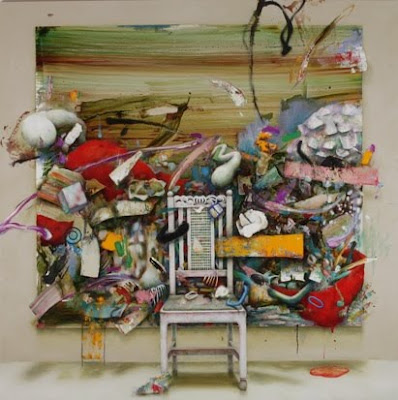
The largest work in the exhibition “Emphasizing the One Who is Absent” (2009) is positioned, both physically and metaphorically, as a portal into the Ogawa’s meta-spaces. This painting-within-a-painting shows an empty white chair set against the background of another canvas that is in the process of falling apart. Pigments explode, smudge off, lift away and the three-dimensional space around the chair is taken over by a barrage of color and action. Juxtoposing the trompe l’oil of the chair with the representations of painterly markings, shapes and traces, Ogawa constructs his own pictorial space, and a temperamental one at that.

For as long as you look at the paintings they challenge and engage, not allowing a moment of the prerequisite calm that would make them into passive objects of your gaze. Practically all the pieces in the exhibition give the impression that the action inside and outside the canvas’ transpires regardless of the viewer’s presence. This is most visible in the series of works where animals (rabbits, tigers, frogs) are shown as they escape the confines of their respective paintings only to look back so they can tease the now barren canvas.
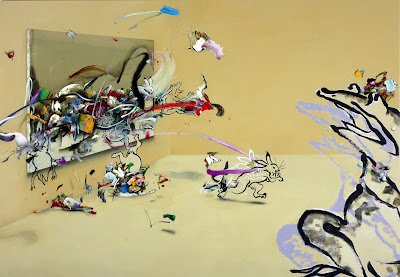
Irritated Figures is curated by Rodion Trofimchenko whose dynamic interpretation of Ogawa’s work goes beyond simply framing the art, and functions as a parallel text of sorts, at once obfuscating and enlightening. As Trofimchenko explains, the irritated images square the artist against both Japanese pop culture and Japanese contemporary art. I must agree that Ogawa’s work for all his incorporation of the traditional Japanese technique and design, at least as they appear in the final product, is rooted in Conceptual art. The best example of this is the stunning silk screen/painting “Play on his own” that contains the artist’s likeness from some twenty two years before and, hovering above his head, a cluster of objects and color markings, an intense vision of a memory (or a premonition) fully unfolded in the pendant painting the “Accumulation of Rhythms” (both 2009).

The works in the exhibition show a clear progression from the earlier pieces that engage mid-career Francis Bacon, to the later spatial gymnastics in “Emphasizing the one who is absent” and the “Accumulation of Rhythms.” Here, of course, fingers could point to Wassily Kandinsky’s experiments circa 1915, but Ogawa’s formalist conceptualism so evident in the 2009 “Floating Rhythm” puts his exploding colors and irritated figures into a category of their own. Ogawa is certainly one young artist to watch.

On view through November 21, 2009.

Images: Emphasizing the one, who is absent/不在者は主張する, 2009, oil/alkyd/watercolor on canvas, 145.5×145.5 (top), Floating Rythm/浮遊するリズム 2009, watercolor/oil/alkyd/pencil on canvas, 80.8×80.8 (middle); Runaway/脱走者, 2009, silkscreen/alkyd/oil on canvas, 112×162 (bottom). Images courtesy of the gallery.

Art and Beer: Kunst Oktoberfest

Halloween was the perfect day to hop on the bus (two buses, to be precise) that were circling the Chuo-ku and Ginza galleries, and see a whole lots of art in a very short time. Twenty six galleries in all, ranging from the more established Galerie Sho Contemporary, nichido contemporary and Koyanagi, to name a few, to the younger Frantic, Wada and CASHI hosted a stream of art and beer lovers. The buses, as it could be expected, ran right on schedule, stopping at each gallery every twenty minutes to give just enough time to skim an exhibition, or allowing to stay longer if the show was bigger or particularly interesting. Due to a trick-or-treating appointment later in the evening I was only able to take advantage of the south route and see about half of the galleries. Here is my short report.

The sculpture of the girl holding a goose by its paws is among several humorous fairy tale fantasies by Hiroshi Ohashi, his works could be seen at Wada Fine Arts in Tsukiji. A disturbing twist on the fairy tale motif is offered by Ryu Ebato’s Emotion works shown at the ART★AIGA in Hachibori. The gallery website describes her paintings as “comical, cute, [and] a little frighten[ed].” The work featured on the Aiga homepage shows Ebato’s protagonist activating the glowing charcoals of her eyes and her agape mouth by a twofold pull on the tresses, thus hitting a hollow note amplified by the transparent layer of acrylic set on unprimed canvas.

On the other end of the visual/sensory spectrum is Ren Jing’s solo exhibition. The young Chinese artist, whose first show in Japan is hosted by Unseal Contemporary, mixes vestiges of Communism (red kerchiefs around girls’ necks) with pain and violence (red eyes, blood smears on girls’ faces). His very accomplished red paintings bring to mind Filip Maliavin’s visions in red, only here the color, rather ominously, links political and sexual bondage.
A floor above Unseal Contemporary is the Frantic Gallery (formerly Art Project Frantic), whose first showing of Haruki Ogawa’s Irritated Figures will be the subject of a separate blog entry. This show will be on through November 21st—a definite must-see.
Some very interesting figurative works were in the group show of Clara Desire, Masako and Motoko Otsuki at Galerie Sho Contemporary. Taguchi fine art was featuring Simon Morley’s word paintings, and Arataniurano presented Izumi Keiji’s wood and epoxy sculptures of figures with fantastic(al) nature-themed outgrowths (now waterfalls, now trees, now rocks) in all sorts of places. The Taguchi and Arataniurano exhibitions will only be on for another week, through October 7th.
Art-filled and fun-filled day indeed, my only wish it could be spread over the whole weekend to keep the aesthetic fatigue at bay.

ULTRA002 is now open!

Last night’s opening reception for the Emerging Directors’ Art Fair inaugurated a six-day long artfair where 50 young curators (some with proper gallery spaces, some without) show their artists’ work.

Art and Fashion

The designer shows of the Japan Fashion Week ranged from Yukii Torii’s über-conservative society wares, to GalaabenD’s androgynous militarized chick, to Yoshikazu Yamagata’s Old Testament couture. In every case the audience, many dressed by the presenting designer, reinforced the brand’s message. There was no confusing the manicured luxury brands-clad crowd at Yukii Torii with the artists and the hipsters at Mikiosakabe or writtenafterwards, much like there was no way of confusing the halls of Tokyo Midtown with a modernist school building of the Taito Designers Village that hosted the last day shows of the JFW.

The three brands that showed on the last day were Mikiosakabe (designers Mikio Sakabe and Shueh Jen-Fang), Akira Naka and writtenafterwards (designer Yoshikazu Yamagata). The fact that the shows were held in a separate (and an artsy) venue went along with the avant-garde aspiration of the designers. In the opening show Mikiosakabe made ample use of the gymnasium location, enhancing its “real life” effects of the scuffed-up wooden floors on the basketball court by the dispersed low lighting and what appeared to be dry ice. Like GalaabenD the day before, Mikiosakabe traded a straight catwalk for something more like a track where the models passed the screen background to continue along the perimeter of the room with the single interruption of three large black cubical steps they had to clime. The official JFW photos show the screen shots, but the oblique view of the cubes was at least as good, if not better.

The performative aspect was further developed in a series of installations and exhibitions bundled with the day’s shows. Among them were a mini retrospective of Yoshikazu Yamagata’s creative forays. It contained the works from the first and the third collections, but the highlight was Yamagata’s introduction to his new collection “The fashion show of the Gods.” Along the axis of the long and narrow room run a display table covered with carbon pieces upon which were arranged small statuettes of various animals, according to an accompanying tag “sleeping animals with the gods.”

A much larger room two doors down the hall housed two installations by the group of performance artists known as Chim↑Pom. One on the objects on display is their SUPER☆RAT that incorporates common variety rats painted in “super” yellow. The Shibuya rat traces the progress of the Superrat that symbolizes, among other things, our own rat-like existence. A simultaneous video installation documented the confrontation between real rats and the rodent-hating Tokyoites.

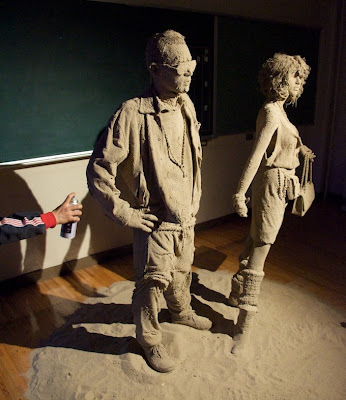
The second work was a performance of a sand-covered member of the group next to a female mannequin, also covered in sand.
As the specks crumbled off the real person who made slight but disturbingly noticeable shifts in position ever thirty seconds or so, another member of the group came to the rescue with a spray can of adhesive and more sand.
Two more rooms were devoted to Ichiro Endo’s live painting and Yuima Nakazato’s shoe art.

Design Festa 30

The Design Festa that took place in Odaiba’s Big Sight complex over the weekend also happened to be the 15th anniversary of the project. It offered a mind-numbing array of displays containing all possible drawing and painting media, design items and performances. As far as art was concerned, my two picks were Fukao Atsushi’s grim naturalistic fantasies and Eun Kyung Kim’s textile prints.

Eun Kyung Kim is a Professor at the Department of Fashion Coordination at Korea’s Yeoju Institute of Technology. His well-coordinated booth looked more like a gallery installation than a regular arts’ fair display. The works, all originally designed, were women’s coats featuring silkscreen prints of monochrome industrial landscapes and garish pink flowers.

Fukao Atsushi is a Tokyo-based illustrator and a graphic designer. The works on display included small format illustrations and CD covers, a medium-size reproduction tagged “Domestic animal party,” and a large digital print of a composition shown on Atsushi’s webpage.

The next Design Festa will be held in May (15–16).

Shinro Ohtake: "Shell & Occupy 4"

Memory of Color 3/Geronimo
2008
Oil, printed matter, photographs, film, silk screen, rice paper, vinyl, cotton cloth, cotton yarn, plant matter, varnish, wood and acrylic in custom frame
47 x 34.5 cm
Image courtesy of the Take Ninagawa and the artist

This is the fourth installment of Shinro Ohtake’s scrapbook art at Take Ninagawa. The exhibition presents a series of assemblages containing spliced magazine pages, stickers, script excerpts, and old photographs topped of with impasto touch-ups in oil. The resulting effect, simultaneously gritty and sleek, is quite remarkable. Ohtake is one of Japan’s pioneers of post-figurative art, his first solo show dating back to 1982. When you visit the exhibit you can pick up a catalogue of all the previously shown Shell & Occupy works; it also contains a well-written and informative essay on Ohtake by Arndrew Maerkle (¥2100). On view through November 28.