Bouke de Vries, Pieces, 2010, detail
Glass, mirrors, variable dimensions, image courtesy of the gallery
Kyoto’s
Super Window Project & Gallery is temporarily pausing its activities at their Motoyama Kamigama location to concentrate on various international endeavors (starting with the gallery presenting their artists at
Artissima 17). In anticipation of this seasonal closing, the SWP has mounted their last exhibition entitled “Pieces” by Bouke de Vries.
The current installation is comprised of two tall thin glass towers filled with glass fragments at once fragile and dangerous. The resulting tension between power and vulnerability is not unlike what I saw in the last SWP exhibition of Soshi Matsunobe’s paper sculptures: ostensibly hard but, in reality, super delicate works. The metaphor of vulnerability is physically manifested in the glass of De Vries’ ephemeral towers due to the timing of the installation. The exhibition was inaugurated on the anniversary of the World Trade Centre disaster, making the semi-transparent glass shard-filled structures function symbolically as well as viscerally.
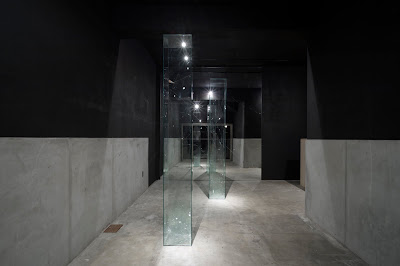
Bouke de Vries, Pieces, installation view, image courtesy of the gallery
Unlike the accumulation sculptures of the New Realists, De Vries’ piled up fragments of ceramics and discarded or found materials are not a commentary on the production-accumulation continuum within modern societies. His boxed “life fragments” seem to refer to the condition of fragility of human existence—what was once real becomes an emblematic representation removed from its original context, and forced into the vacuum of glass encasement. In De Vries, the materials that used to form the fabric of peoples’ lives now exist only as fragments, “pieces” which encapsulate the memories of things past.
The show will be on through October 24.
Comments Off on Kyoto: Bouke de Vries "PIECES"
 Here is link to my Critics’ Pick of “Nanugi Agency” show from Seoul. It is hosted by a recently opened nonprofit foundation ART + LOUNGE DIBANG. Definitely worth a visit if you are in Seoul before the end of this month.
Comments Off on ARTFORUM Critics’ Picks: “Nanugi Agency” (Seoul)
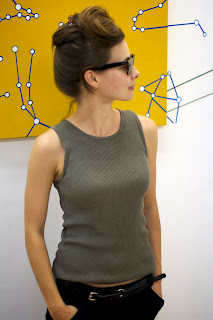
The 3331 ARTS CYD is currently holding a solo exhibition by Anna Fryer (formerly Zmyslowska). Some may remember her work from the last year’s graduation show with Tokyo University of the Arts (Tokyo Geidai), where she is currently working on her PhD in painting.
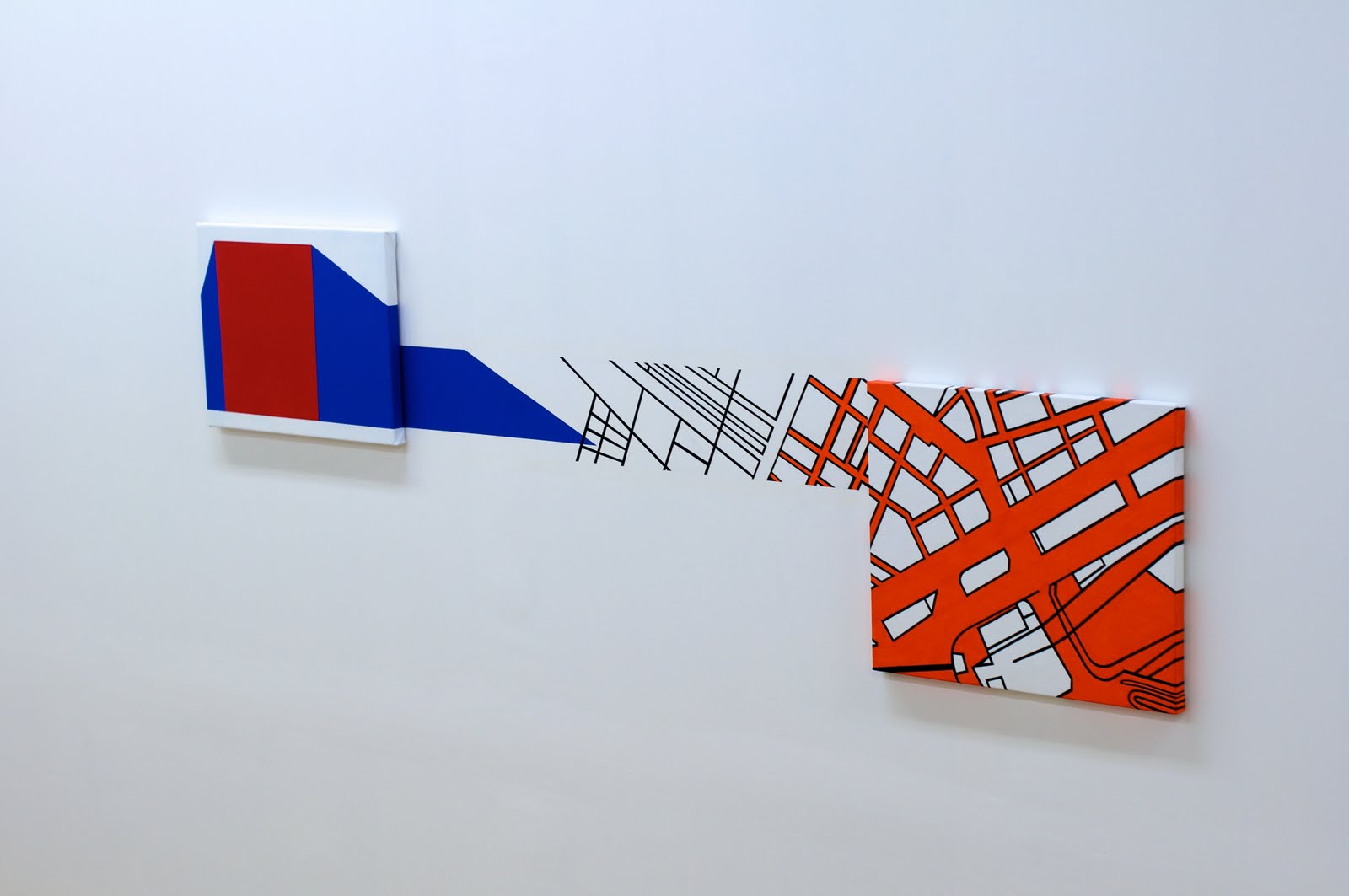
Outwardly, the biggest difference from her recent contribution to Tokyo Geidai show is Fryer’s ample use of the wall to expand her painting beyond the canvas itself (although she has worked with incorporating the wall space earlier, for her solo exhibition “ATMOSPHERIC” held in Sapporo in 2009). The fifteen works in “FRICTION” are arranged in seven clusters of two or three with painted spaces between them.
As she challenges the limits of the frame, Fryer expertly avoids any semblance of decorativity inherent in an extension of the painted surface onto the wall. Moreover, she takes advantage of this newly constructed space to add an extra dimension to her painting, moving her works towards the spacial/painterly constructions El Lissitzky would have approved.
The show will be on through September 27. More information about the artist is on her website.
Comments Off on Anna Fryer "FRICTION" at 3331 ARTS CYD

Nobuyoshi Araki, “Koki No Shashin : Photographs of A Seventy Year Old” 2010, RP Direct print, Courtesy of Taka Ishii Gallery
My review of Nobuyoshi Araki’s anniversary exhibition “Koki No Shashin : Photographs of A Seventy Year Old” held at the Taka Ishii gallery earlier this summer is now out in the September issue of Artforum.
Comments Off on Nobuyoshi Araki ARTFORUM review
This and the following few posts should have come out weeks ago, after my recent trip to Kyoto in early July, but were set aside because I was on a deadline for the last round of corrections on
my book, and had to handle the usual end of the term papers/exams/grading routines. I am done with both now and will take the next couple of weeks to catch up with my postings.
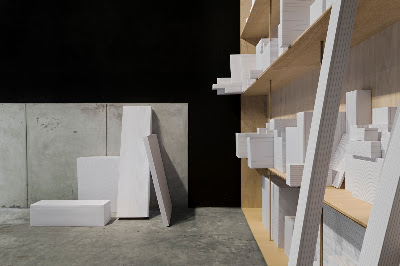
Soshi Matsunobe, installation view at the Super Window Project gallery. Image courtesy of the gallery.
The Super Window Project in Kyoto has two simultaneous exhibitions at two different venues. The main gallery houses an installation by a young neo-minimalist artist Soshi Matsunobe whose works could serve as illustrations for Donald Judd’s definition of sculpture as “specific objects in literal space.” Matsunobe’s sculptures are made of paper and covered with geometric linear overdrawing in black ink—most of it parallel lines placed at regular intervals. The objects are stacked in various configurations in or around large plywood shelflike display case, with few elongated pieces leaned against the wall and the largest work placed directly on the floor. The arrangement is very precise, in part, because of the optical interaction between the black-on-white linework and the matte black walls of the gallery. Still, Baron Osuna, who curated the show, avoided any semblance of decorativeness, as he allowed the objects to dominate the space and not be subsumed into the larger design scheme.
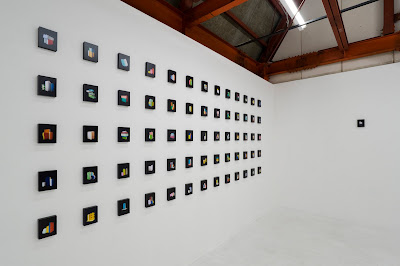
Takashi Suzuki, “Bau” series (100 photographs), 2009, C-print on wood. 8,5 x 11cm. Edition of 3 + 2 AP.Courtesy Super Window Project, Kyoto. ©2009-2010 Takashi Suzuki.
The second Super Window Project exhibition is at a different location in downtown Kyoto. It showcases the latest work of photographer Takashi Suzuki, a Kyoto-based artist who trained in Boston and Dusseldorf. The photographs are mounted on wood, and, just like Matsunobe’s paper sculptures have a have a distinct “object” feel to them, but one’s perception of the artwork is quite different if the images are seen before the mounted photos. I first encountered these photographs projected on a screen during an artist talk event held at the gallery on July 4, which made me to conceptualize the works in much more formal terms. At the time, Suzuki presented this latest works as an investigation of architecture through photography. The cycle, entitled Bau, shows constructions made of household sponges stacked to imitate architectural shapes. Because the photographs are taken from a 45 degree angle the constructions look almost monumental despite the humble nature of the material that composes them. This re-assignation of meaning reflects Suzuki’s intention to examine how the viewers gather and process visual information, and to understand the mechanisms behind visual cognition. By defamiliarizing the object (sponges), the artist denies their primary function in order to create a new paradigm in which lasting and disposable collide.
Comments Off on Kyoto: Super Window Project
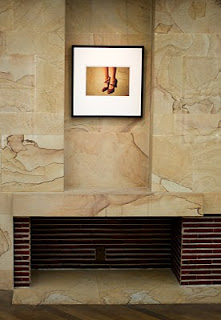
My review of William Eggleston’s Paris-Kyoto show at the Hara Museum of Contemporary Art has just been posted on the Artforum Critics’ Picks.
If you would like to see more of Eggleston’s work, SCAI THE BATHHOUSE gallery is now showing him as well. Their exhibition, William Eggleston: 21st Century will be on view through August 4.
Comments Off on William Eggleston ARTFORUM review

The Kodama Gallery in Kyoto just closed their latest show of Kenji Nohara.This is the artist’s third exhibition with Kodama, the previous one was held in Tokyo last November. There were several already familiar works (a plant-like sculpture whose trunk is “planted” in a large pot and whose with molecular-looking leaves have the underside of playing cards, a Mexican souvenir mask lined with fractured mirror fragments, and the groupings of ameba-shaped mirror puddles). A sliver of gallery space was partitioned off for a separate installation of an alley-coffee-house. According to the artist, this installation combines his ruminations on the cultural importance of back alleys, and his memory of a particular coffee house where an old man, visible only from the back, was playing the game of chess—the clicking of the pieces interrupting the silence. The alley-coffee-house is squeezed into a tight space that ends in a sharp-angle lined with mirrors. A heating lamp pointed at a plush cherry red velvet chair keeps the front of the shop realistically warm, while faint tapping stands or the sound of a virtual chess match.
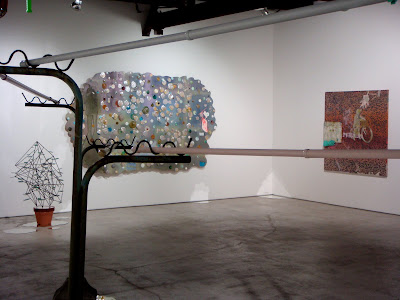
The show also featured half a dozen new large-format paintings, some containing found objects, and an interesting grouping of small multi-media collages. Among these, one collage departs from the basic rectangular format because the thickness of its right margin is almost double of its left. The resulting effect is that of a book left ajar: something presently invisible is about to be revealed.
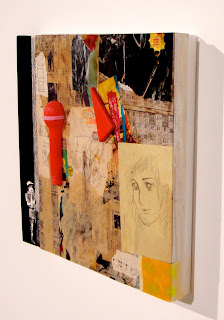
The theme of pending disclosure repeats in the left section of the collage where a boy scout voyeuristically peeks around an imaginary corner at a vintage pencil drawing of a wide-eyed girl. In my opinion, it is the act of looking that connects these new collages and themirror sculptures: a perfunctory first look, must be followed by a scrutinizing study of the subject, still even then seeing the whole work would possibly require a system of multiple mirrors or some other such magical device for unpacking the artist’s imagination.
Comments Off on Kyoto: Kenji Nohara "Cloudy to Fine Play"