The winner of the 2010 Bacon Prize is Keisuke Tanaka whose work was on view in the Yamamote Gendai Gallery’s booth. Tanaka’s mixed media installations (the one in the show was acrylic on camphor tree, lead and natural pigment) appear organic. As is the case with many other artists represented by this gallery, his works inhibit the world brought into being by their creator: at once unique and hermetic.
Comments Off on Bacon Prize 2010 Winner—ART FAIR TOKYO

This was my first encounter with Erina Matsui’s whimsical works; her solo show “One-touch Time Machine” is on view at Yamamoto Gendai through May 1. The young artist creates a carnivalesque universe where the lips on a giant face are transforming into slimy mushrooms right before our eyes, heads grow out of the ground, and weird creatures spew out cotton tissues. As I was looking at the mixed media works and paintings I could not help but think about the hermetic quality of the world Matsui depicts. There is nothing extraneous, every bizarre creature, every doll, every mushroom and celestial figure has its proper place. And, at the exhibition opening, amidst all that splendor the artist herself, clad in a big yellow crinolined dress was eagerly posing in front of her works as if shown how to inhabit her fantastical world properly.
Erina MATSUI, No! Never, 2010, H146xW112cm, Oil on canvas, ©Erina MATSUI
Against the prevailing background of artistic gravitas and lofty detachment shared by the majority of interesting art in various Tokyo galleries, Matsui’s work initially seems too cute, even old-fashioned, but her sincerity and consistency prove otherwise. She is a storyteller and a good one too.
Comments Off on Recent Openings: Yamamoto Gendai
Posted
on April 4, 2010, 5:19 PM,
by jfriedman,
under
Art Fair Tokyo,
Gallery Kogure,
Gallery Koyanagi,
Gallery Simon,
Koh-Jutsu,
Kouji Ohno,
Morgan Tschiembe,
Röntgenwerke AG,
Super Window Project,
Yoshihiro Suda.

Art Fair Tokyo, Contemporary Art section
The 2010 Art Fair Tokyo was inaugurated last Thursday at the Tokyo International Forum. Most of the exhibitors were located in one of the large halls, with some of the younger galleries and media stalls situated in two separate sections, in the upstairs lobby. The fair covered a whole range of media (modern and contemporary two and three-dimensional works, video, Chinese and Japanese pottery, Nihonga artifacts, ukiyo-e prints, etc.) and time periods (from 12th century onwards). While the bulk of the participants came from Tokyo, Osaka, Yokohama and Kyoto, there was also a sprinkling of galleries from places like Canada, China, Germany, Korea, Spain, even Russia. The majority of the booths were fairly conventional, but the upstairs lobby “Projects” section had some very interesting displays: Yokohama’s Gallery Simon arranged a dramatically lit space to showcase the works of Kouji Ohno (Storage Element, 2010), Kyoto’s Super Window Project TM & Gallery had Morgan Tschiember’s installation Solid Geometry (2009). The temporal and geographic diversity of the art fair played both ways: while it was fascinating to see the older paintings and artifacts, the sensory overload made it difficult to appreciate many of the contemporary works.

KOH-JUTSU installation view. Works by Satoshi Uchiumi, Akiko & Masako Takada and Yoshihiko Satoh
The Art Fair Tokyo had closed yesterday, but the other seasonal show, a much smaller one, is still on across town, at Omotesando’s Spiral. The KOH-JUTSU exhibition organizer Röntgenwerke AG did not take part in the Art Fair Tokyo. Instead, together with Gallery Koyanagi and Gallery Kogure it put together a selection of works by their artists in the generously-sized first floor gallery of the Spiral Hall. The exhibition is curated by Tsutomu Ikeuchi. Röntgenwerke gallery’s choice not to exhibit at this year’s Art Fair Tokyo, instead organizing a concurrent show in a venue other than their flagship space in Bakurocho seems like a bit of a rebellion against the necessary uniformity of the large fair. Of the other two participants in the Spiral show Gallery Koyanagi did take part in the Art Fair but had a super-minimal and, perhaps because of that, the most stunning display. I wonder if the single flower sculpture by Yoshihiro Suda was also a way of resisting the store-front model of the Fair.
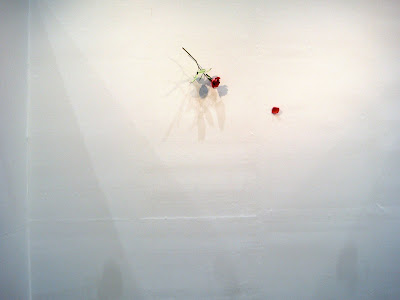
Yoshihiro Suda at Gallery Koyanagi booth, Tokyo Art Fair
The Koh-Jutsu show will run though this Wednesday, April 7th, admission is free.

BK0, 2009, acrylic on canvas, 90 x 160 cm. Photographer: Sangtae Kim, photo courtesy: artist, Kukje Gallery.
My review of MeeNa Park’s recent work has just been posted on the Artforum Critics’ Picks. This RISD graduate is having her first solo show at the Kukje Gallery in Seoul.
Posted
on March 18, 2010, 8:47 AM,
by jfriedman,
under
Uncategorized.
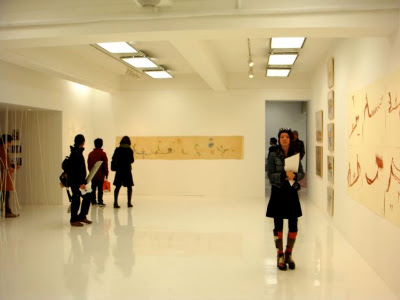
The inaugural exhibitions in 3331 Arts Chiyoda complex proved to be as exciting as I have anticipated. The renovated space of the former school had just enough of the old spirit to make the venue not seem white cube commercial, yet, the remodeling of the classrooms-come-galleries was to a high standard—in the fully finished spaces (some are still under construction, others have not been tackled) even the doors were tagged with exhibitors’ names in the way a nice gallery would do done it. The works on view varied in size and approach with a good range of media and expected viewer participation—the “Look if you like, but you will have to leap” was more than a vain threat.
Hopefully, 3331 will continue to thrive as an exhibition venue to showcase the young talent, and, starting in September, as a hub of training “those wording towards a professional engagement in the arts”—this program will start with a short tester course in May.
Please consult the 3331 Arts Chiyoda page for more information about this intitiative.
Comments Off on 3331 ARTS CYD

This year’s Roppongi Crossing exhibition poses a mega-rhetorical question: “Can There Be Art?” We know the answer, of course, but for the sake of doing a convincing lineup of the new talent, the Mori Art Museum built the show around the theme of street-generated art using the works works of young Japanese artists. Similarly to the VOCA exhibition, the Roppongi Crossing participants were chosen by a team of contemporary art professionals, in this case three Mori curators. But unlike VOCA that limited itself to the two-dimensional works, the Mori show offers a variety of different media. The exhibition will culminate in the allocation of the “People’s Prize” which will be announced on June 13. If you visit the exhibition by June 8th you will have a chance to put your vote in the ballot box. I copy below the list of artist whose work will be on view from March 20 through July 4. Do not miss Artists’ Talks on March 20th and June 5th (both 14:00 to 16:00) and check the “Public Programs” page for performance times.
Aikawa Masaru
Amemiya Yosuke
Aoyama Satoru
Chim↑Pom
contact Gonzo
Dumb Type
HITOTZUKI (Kami + Sasu)
Kato Tsubasa
Koganezawa Takehito
Morimura Yasumasa |
Rogues’ Gallery
Shiga Lieko
Suzuki Hiraku
Takamine Tadasu
Teruya Yuken
UJINO
Yahata Aki
Yokomizo Shizuka
Yoneda Tomoko |
Comments Off on Roppongi Crossing 2010

B
eginning in 1994, a group of Japanese curators and art critics put together an annual exhibition of about three dozen young emerging artists whom they want to spotlight. The exhibition, now hosted by the Ueno Royal Museum, is accompanied by a bilingual catalogue where these curators and critics introduce their nominees in short essays. Because the participants must be selected from among many whom the nominator believes to have a particular promise this exhibition is very selective: after all, each of the people who endorse have to put their art-critical weight behind just one contemporary artist. This year’s VOCA opens February 14 and will run through the end of the month. The webpage for the event appears to be in Japanese only, so you might want to note the address of the venue (Ueno Royal Museum): 1-2 Ueno Park, Taito-ku.