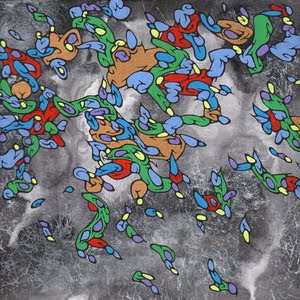
untitled (無題)
2009
230mm×230mm
アクリル・顔料インク・紙
Copyright (c) Katsuhiro Maeda All rights reserved.
Amongst the one hundred budding artists, showcased in this year’s Wonder Seeds exhibition held at the TWS in Shibuya, there are several whose works could grace the walls of Tokyo’s better galleries. More or less arbitrarily, I would like to comment here on two of them. The first is a graduate of the Tama Art University Katsuhiro Maeda (class of 2002). The painting on display at the Wonder Site (each participant was represented by a single entry), was a non-objective composition in which small colorful shapes outlined in black were floating above the gilded Nihonga background. Because the wooden panel that served as the support was not varnished, the combination of these matte shapes with organically reflective gilding was highly contrasting and, at the same time, complimentary. Maeda found a very successful way of combining traditional Japanese art with contemporary investigations of space and color: neither upsets the internal balance of its counterpart, both are indispensable for the final work.
The second young artist is Hiroko Sasaki, I will do a separate post about her shortly.
The sale of the works from the show is conducted by the Gallery Tagboat.
Comments Off on Wonder Seeds 2010: Katsuhiro Maeda

O
n Sunday, March 14 Tokyo will add another contemporary art initiative—3331 Arts Chiyoda, to the very happening network that goes under the umbrella name of Tokyo Wonder Site. The new three-story art center will open in a renovated high school building in Akihabara, and will incorporate a variety of spaces, labs and galleries housed in the former classrooms. There is not much on the Arts Chiyoda website in their statement of purpose section (although the initiative name explanation is a gem), but a close look at the schedule page is very promising. The center’s inaugural exhibition “Look if you like, but you will have to leap,” consists of six separate projects whose shared goal is to engage the viewers, and to promote artistic collaboration that straddles the making/looking divide. For all the utopianism of3331 descriptions their featured exhibitions look fresh and exciting. I am certainly looking forward to going!
Comments Off on Clear Your Calendars for Sunday, March 14

My review of Tamotsu Ikeya’s show in the Kyoto branch of Kodama Gallery has been printed in the March issue of Artforum.
Posted
on March 3, 2010, 7:36 PM,
by jfriedman,
under
Uncategorized.

Dear All,
Some of you were asking why there were no blog postings in February. The answer is simple: after wrapping up all the exams and grading for the Fall semester I had to give my full attention to final manuscript revisions for my monograph on Alexei Remizov. It is being published by the main division of Northwestern University Press, and will be available later this summer. If you would like to know more about the the book, here is a link to the NU Press‘ page. Thank you for checking in on me.
Comments Off on Re: No postings in February

IHN Gallery in Seoul is showing the second installment of JeongMee Yoon’s photographic series “The Pink and Blue Project.” The idea behind the series was simple enough—to examine what conditions children’s blue and pink preferences: is it nature, nurture, marketing?—but Yoon’s execution is both meticulous and imaginative. The first set of photographs, in most cases taken in 2006, shows their subjects (little girls and boys) encircled by their color-coded possessions—pink and blue, respectively. Shot with the wide-angle lens, the images initially overwhelm by the mass of monochrome objects big and small. In the pink prints in particular, the girls seem to blend into the field of pink dolls, dresses and books.

The Pink Project I – Maia and Her Pink Things, 48×48″, Light Jet Print, 2006, ©Jeongmee Yoon, Image courtesy of the artist

The Pink Project II – Maia and Her Pink & Blue Things, 48×48″, Light Jet Print, 2009, ©Jeongmee Yoon, Image courtesy of the artist
Fast forward another three years, to 2009, and the same children pose in updated interiors. The boys, of course, are still proudly showing off their cars and sports parphanelia. The girls, many having “graduated” out of pink and into blue, are now independent from their background. No longer cute live ornaments swathed in pink and matching their arranged surroundings, the girls appear to take charge over the multitude of objects around them. It could be just the function of color (colder blue does not subsume their pinkish skin), or it could be my own reading based on the ubiquitous assumption that pink=marketing of girlhood=compromised personality. In either case, Maia and Her Pink Things, (2006) compared to Maia and Her Pink & Blue Things, (2009) is a case in point. In the early print the girl is subsumed into the pink arrangement, in fact the pink bear and the Disney princess are more visible than Maia herself. In the later version, where she is posed on the dividing line that splits the room diagonally into pink and blue parts, the pink portion is in the background, appropriately, providing an interior version of atmospheric perspective. That is the limit of its function in the image. Meanwhile, the blue segment (of which Maia is now a part—she is wearing a blue top), lets the viewer know unequivocally the relative place of the person and her possessions—Maia is the focus here.
You can see more of Yoon’s work on her webpage.
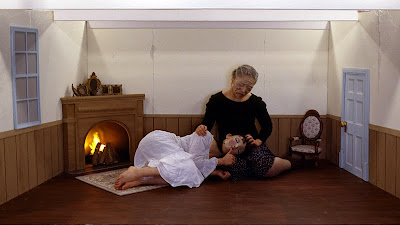
“Lullaby,” 2009, 12 minutes, edition of 5, image courtesy of the gallery
Kyoto-based photographer Miwa Yanagi is known for her series of images that examine actual and mythical female identities. Her heroines are devoid of commonplace anxiety of time-triggered decay; they only gain from aging that brings the long-sought liberation from their circumscribed societal roles. Yanagi’s 2009 cycle of digital photographs “Windswept Women” was chosen to represent Japan at the 53rd Venice Biennale and generated quite a range of critical reactions. Last year she was also exhibited at the Tokyo Metropolitan Museum of Photography, and at the National Museum of Art in Osaka. Her latest work is now on view at the Rat Hole Gallery gallery in Omotesando. The centerpiece of the eponymous show—a twelve-minute video “Lullaby” is in a dialogue with several of the artist’s silver gelatin prints from the fairy tale series of 2004–2006.
I will follow-up with a link to the full review of the Rat Hole Gallery exhibition in the next few days.
Comments Off on "Lullaby" by Miwa Yanagi

Akiko Yanagimoto, Self-portrait Buddha, 2008, ceramics, 18 x 16 x 10.5 cm
This inaugural joint exhibition of several artists represented by ZENSHI and Yuka Sashahara opened last night at the old ZENSHI location. Its title—”Lucky Fortune”—references the auspicious events of the New Year, and the works in the show offer a range of light-hearted and playful ways to celebrate it.